

Keith Ammon, New Hampshire State Representative for New Boston, Mont Vernon, Lyndeborough and Vice Chair of Commerce and Consumer Affairs, opened a discussion on the potential of diversifying the state’s financial reserves into Bitcoin ETFs. His comments, posted on X (formerly Twitter), highlight a dramatic what-if scenario that underscores the explosive growth of BTC over the last decade.
What Bitcoin Can Do For New Hampshire
Ammon’s reflection on the state’s financial decisions comes at a time when BTC and other digital assets are increasingly being acknowledged by major institutional investors. His detailed analysis posited, “Should the State of New Hampshire investigate allocating a small percentage of its reserves into a Bitcoin ETF? Of course, hindsight is 20/20, but had the State of NH put just 5% ($4.65M) of its 2016 $93M rainy day fund into Bitcoin and held it, that amount of BTC today would be worth nearly half a billion dollars ($473M), a 10,000% ROI.”
This assertion follows a surge in institutional interest in BTC as a viable asset class. According to recent insights from BlackRock, the world’s largest asset manager, there has been a noticeable increase in Bitcoin ETF investors, which now includes entities like sovereign wealth funds and pensions.
Additionally, Ammon cites Manuel Nordeste, Fidelity’s Vice President of Digital Assets, who recently highlighted the growing trend among major pension funds and big banks towards spot Bitcoin ETF allocations, driven by an escalating interest in the digital asset market. “25% of pension managers present at a recent panel personally owned digital assets. If just 1% of state pension AUM ($5.5T) flowed into BTC, it would dwarf mining revenue, leading to a supply shortage relative to demand and a price increase for Bitcoin,” Ammon stated.
Reflecting on the potential future impacts, Ammon also referred to a prediction by Cathie Wood, CEO of Ark Invest, who has forecasted a significant rise in Bitcoin’s value. Wood speculates that Bitcoin could reach $3.8 million per unit by 2030 if institutional investors allocate more than 5% of their portfolios to the cryptocurrency.
Utilizing this prediction, Ammon extrapolated potential returns for New Hampshire, “If NH invested 5% ($14.5M) of its $290M rainy day fund balance into a Bitcoin ETF at today’s prices and held it until 2030, it would be valued at nearly one billion dollars ($900M), a 6,200% ROI.”
The implications of such investments extend beyond mere speculative gains. New Hampshire faces outstanding liabilities totaling approximately $1.45 billion, including $1.25 billion to the state pension system and around $200 million in bonds.
Ammon argues that exploring alternative investments like Bitcoin could be a viable solution to these financial challenges, suggesting, “How could we climb out of that hole? The answer may be staring us in the face, and it’s worthy of further investigation.”
Reactions from the BTC community and financial experts were prompt. James Lavish, a noted Bitcoin authority, underscored the importance of this consideration from a fiduciary responsibility perspective.
He remarked, “The simple answer is yes. A more involved answer is: To not at least investigate a possible allocation in Bitcoin would be a breach of fiduciary duty, considering the alarming deficit levels and exponentially expanding federal debt.”
Dennis Porter, CEO and co-founder of Satoshi Act, a non-profit advocating for Bitcoin mining in the USA, succinctly supported the notion with, “You know my answer.”
Ammon’s proposal underscores the growing politicization of Bitcoin in the US, highlighting a shift towards crypto becoming a significant electoral issue. This trend is further evidenced by former US President Donald Trump’s recent pivot towards a pro-BTC and crypto stance, aiming to leverage this position in his bid to return to the White House.
Trump’s change of heart marks a notable development, reflecting the increasing relevance of crypto in political strategies and national economic discussions.
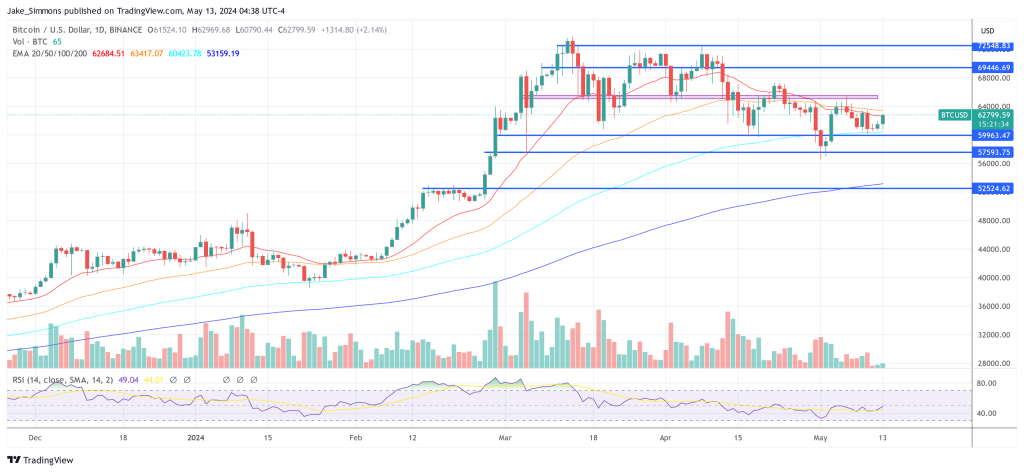
At press time, BTC traded at $62,799.