

In an interview with Natalie Brunell, Luke Gromen, a renowned macroeconomic analyst and founder of FFTT LLC, shared his insights on former President Donald Trump’s potential influence on the Bitcoin price. The discussion centered around Trump’s campaign promise that he will establish a strategic Bitcoin stockpile and his comparison to oil.
Bitcoin As ‘The New Oil’
When asked about Trump’s interest in accumulating up to a million Bitcoin over the next few years and its global impact, Gromen delved into historical parallels and strategic economic maneuvers. Gromen recalled Trump’s statement at the Bitcoin 2024 conference, where Trump said, “Bitcoin is the new oil.” This comment piqued Gromen’s interest, prompting him to explore deeper strategic implications beyond mere “pandering for votes.”
Gromen recalled Trump’s comment from August where he said that he will “pay off US debt with a little Bitcoin.” According to the economist this “was a really odd comment. I started to wonder if Bitcoin is the new oil. That Bitcoin is going to be inflated like oil.”
He highlighted a historical event from the early 1970s: “If we go back in time to late ’73, early ’74, oil rose in price by 400% from October ’73 to April ’74,” Gromen noted. He referenced an interview with former Saudi Oil Minister Ahmed Zaki Yamani.
“There is an interview that was given on CNN International by the former Saudi Oil Minister Ahmed Zaki Yamani in 2010 in which he said there was a meeting of the Bilderberg Group. At this Swedish Island in late ‘73, October ‘73, Henry Kissinger attended and said look the price of oil. [It] is going up 400%. Get on board. And it happened. And again these are not my words. These are the words of the former Saudi oil Minister on CNN,” Gromen stated.
According to the economist, the US was making “the oil market big enough to back US deficits” by recycling petrodollars into US debt, effectively ending the gold standard and establishing the new oil standard. “[It] basically fixed the US fiscal problem post Vietnam War and after we left the gold standard, it basically put us on an oil standard,” Gromen remarked.
Gromen suggested that a similar strategy could be applied to Bitcoin today. “I started to wonder if Bitcoin is the new oil—that Bitcoin is going to be inflated like oil was so that it will inflate stablecoins, so that stablecoins will buy a lot more Treasury [bills],” he explained. By significantly increasing the Bitcoin price, the US could potentially attract global capital into Treasury bills through stablecoins, thereby addressing its acute debt issue.
He referenced a recent report by the Treasury Borrowing Advisory Committee (TBAC), which included two supplements—one highlighting the unsustainable US fiscal situation and another discussing “Digital Assets and the Treasury Market.” Gromen interpreted this as “the biggest banks telling the Treasury how digital asset markets could help finance this acute US fiscal and debt problem.”
Paul Ryan, former Speaker of the House, also entered the discussion. Gromen mentioned Ryan’s op-ed in The Wall Street Journal, where Ryan posited that “stablecoins could help the US with its debt problem.” This alignment of perspectives from influential figures led Gromen to consider a coordinated strategy involving Bitcoin and stablecoins to bolster the US economy.
“We need a way to weaken the dollar while strengthening the dollar system,” Gromen asserted. By inflating Bitcoin’s value, the US could potentially “increase stablecoins, increase stablecoin demand for T-bills,” and draw in dollars from around the world into the US financial system. This could simultaneously address the debt issue and stimulate the economy.
Gromen emphasized that his views are speculative and based on recent observations. “It’s a relatively new view; it’s not that strongly held,” he admitted. However, he finds the convergence of Treasury reports, political commentary, and historical parallels compelling. “I think they’re looking at it in this regard. I really do,” he concluded.
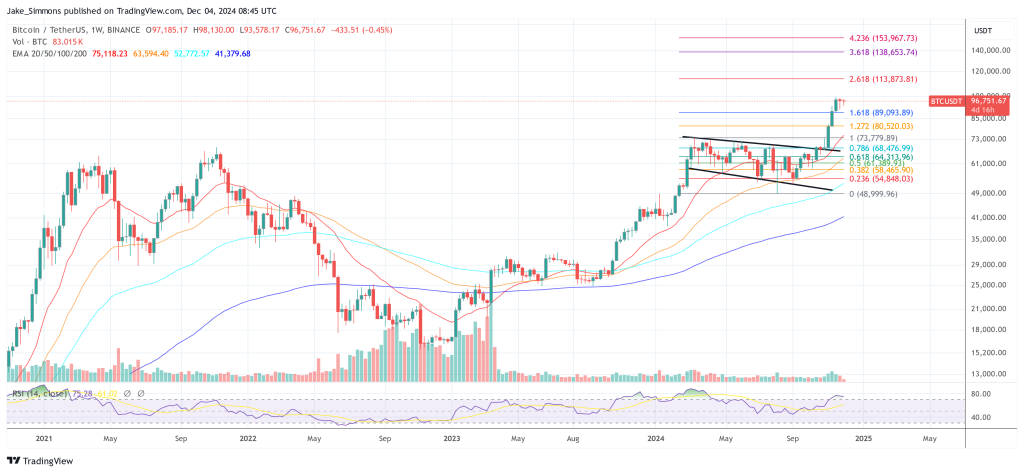
At press time, BTC traded at $96,751.