

Coinbase Ventures has outlined a roadmap for where it expects the next wave of crypto value creation in 2026, centering on real-world asset perpetuals, specialized exchanges, “next-gen DeFi,” and the convergence of crypto with AI and robotics. The firm presents the document as an answer to the recurring founder question: “What should I build next?” and says it is “actively looking for the right teams to invest behind in these categories.”
The team argues that 2025 quietly reset crypto’s foundations. They highlight “stablecoin infrastructure reshaping payments,” cross-chain proofs collapsing settlement times “that once took days,” and new DEX models that enabled “markets for everything onchain.” Regardless of current price action, Coinbase Ventures writes: “We are as bullish as ever about what’s next.”
Major Crypto Trends For 2026
The first major theme is real-world asset derivatives. Kinji Steimetz argues that “RWA perpetuals” are emerging as the fastest way to bring offchain assets onchain, describing perpetuals as “crypto’s most proven trading product” and “a structurally faster and more flexible path than tokenization.”
Because perpetuals do not require custody of an underlying, Coinbase Ventures expects “the perpification of everything,” with “markets [forming] around virtually anything,” from private companies to economic data prints. Steimetz also links this to macro integration, noting that as crypto traders become more sophisticated, they will seek onchain exposure to “oil, inflation breakevens, credit spreads, and volatility.”
A second cluster focuses on market structure and trading interfaces. On Solana, Steimetz points to “Prop-AMMs” where resting liquidity is only executed via aggregators, insulating LPs from “predatory flow.” This “prop-driven approach,” the blog argues, could “meaningfully advance market structure innovation ahead of base-layer improvements” and is not limited to Solana spot markets.
In parallel, Coinbase Ventures sees prediction markets as “one of the leading consumer crypto applications,” but still hampered by fragmentation reminiscent of early DeFi. Jonathan King expects “prediction market aggregators” to become the “dominant interface layer,” consolidating more than $600 million in liquidity and providing an Axiom-like terminal for event contracts. He imagines trading terminals with “advanced order types, filters / charts, multi-venue routing and position tracking, cross-venue arbitrage insights, and more.”
Under “Next-gen DeFi,” the firm highlights three fronts: composable perp markets, unsecured credit, and privacy. Perpetual futures, it argues, are evolving from isolated venues into building blocks for capital-efficient systems where users can “simultaneously hedge, earn, and leverage without sacrificing liquidity.” Coinbase Ventures notes that perp DEX volumes have reached roughly $1.4 trillion per month and grown about 300% year-on-year, and expects 2026 to see deeper integrations with lending protocols so collateral can earn yield while backing leveraged positions.
On credit, King calls unsecured, credit-based money markets “DeFi’s next frontier,” pointing to $1.3 trillion in revolving, unsecured US credit lines as the addressable opportunity. The blog envisions models that blend onchain reputation with offchain data to unlock “unsecured lending at scale,” while warning that the core challenge is “designing sustainable risk models that scale.” If that can be achieved, Coinbase Ventures argues that DeFi becomes “genuine financial infrastructure that can outcompete traditional banking rails.”
Privacy is framed as a prerequisite for institutional and mainstream adoption. Ethan Oak notes that institutions and professional traders “cannot trade if they constantly leak their strategies,” and that ordinary users do not want “their entire financial history” exposed onchain. The team sees growing developer energy around privacy-preserving assets such as Zcash, private orderbooks and borrow-lend protocols, and “dedicated blockchains for payments touting privacy as a raison d’etre.” They highlight advanced cryptography – “ZKPs, FHE, MPC, TEEs” – as tools to let blockchains “maintain their verifiability while reducing user’s public exposure to bad actors.”
The final category connects crypto with AI and robotics. On robotics, Steimetz points to a shortage of “fine-grained physical interaction data such as grip, pressure, or multi-object manipulation,” and suggests that incentivized data-collection schemes inspired by DePIN “could offer a viable framework” for scaling these datasets.
On identity, Hoolie Tejwani warns that we are “approaching the tipping point where everything you see on an internet connected digital screen will be disassociated and indistinguishable from human provenance vs. AI generated.” Coinbase Ventures argues that “a combination of biometrics, cryptographic signing, and open source developer standards” will be crucial to any “proof of humanity” solution, noting that Worldcoin has been “ahead of the curve” but stressing they “would love to support multiple approaches.”
Finally, King describes AI for smart-contract development as nearing its “GitHub Copilot moment,” predicting that AI agents will let “non-technical founders [launch] onchain businesses in hours, not months,” by handling “smart contract code generation, security reviews, and continuous monitoring.”
Looking ahead to 2026, Coinbase Ventures says it is “energized by the builders taking big swings and pushing the onchain economy forward,” but concedes that “the most exciting projects often come from places no one expects,” leaving the door open for theses that have yet to be written.
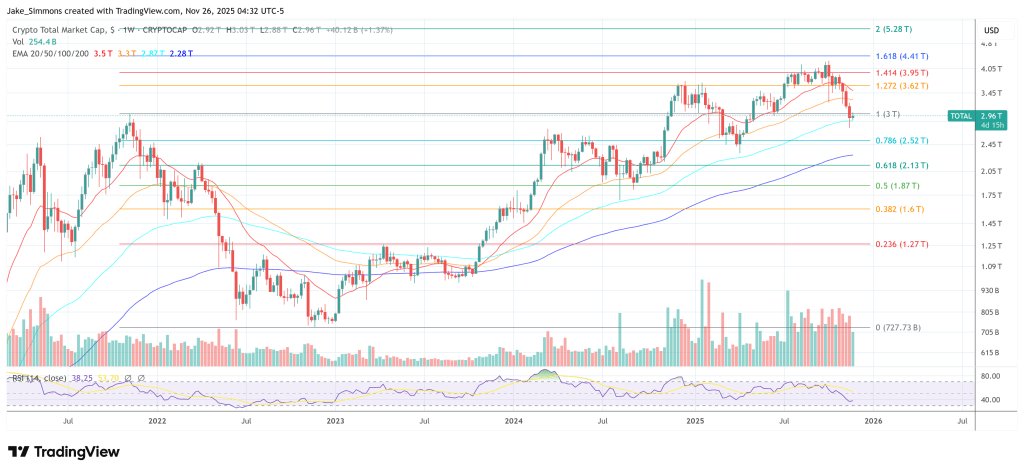
At press time, the total crypto market cap stood at $2.96 trillion.