Ripple’s Chief Technology Officer David Schwartz argued that large internet companies will inevitably adopt blockchain-based finance, contending that decentralized infrastructure is arriving “at the right place at the right time” to meet needs that legacy rails struggle to serve. The remarks came in Episode 1 of Ripple’s new Onchain Economy video series, published on September 25. In the segment, Schwartz frames decentralized finance as a practical response to unmet enterprise demand rather than a speculative detour.
Ripple CTO Foresees DeFi Eating Into TradFi
“Tech is coming for finance with or without blockchain. It was what was going to happen,” Schwartz says, singling out hyperscalers and platform companies: “New corporations, companies like Amazon and Uber need more financial services than the current system is able to provide them. And the blockchain technologies are in the right place at the right time.” He presents the thesis bluntly: this is less about converting traditional banks to crypto orthodoxy and more about meeting the operational realities of software-driven businesses that require programmable money, continuous settlement, and composable workflows.
Schwartz also distances his argument from the narrower, speculative corners of crypto. “It can’t just be collectibles and it can’t just be… seeking very high reward at very high risk,” he cautions, before asserting that DeFi—broadly defined to include smart contracts and the infrastructure around them—will “take a huge bite out of TradFi over the next couple of years.” The condition, in his telling, is straightforward: the blockchain sector must ship services people actually want from a financial system, and do so with institutional-grade guardrails.
That bridge between decentralization and compliance is the crux of the episode. “I don’t think there’s a tension between institutional adoption and decentralization,” Schwartz says. What institutions want from a base layer, he argues, is the very thing public chains offer: neutrality. “Ecosystems are interested in layer-1 blockchains because of their decentralization, because of their neutrality… institutions will see that the neutrality of blockchains is a positive rather than a negative.” In other words, neutrality is not a governance liability; it is the feature that allows multiple counterparties to cooperate without surrendering control to a single gatekeeper.
Schwartz’s comments land amid Ripple’s broader push to position XRPL as a venue for institutional on-chain finance—stablecoin flows, tokenized assets, and eventually native credit—supported by compliance-enabling primitives.
In a September 22 analysis on its corporate site, Ripple asserted that XRPL recorded $1+ billion in monthly stablecoin volume and ranks among the top chains for real-world asset activity, framing a roadmap that emphasizes verifiable credentials, “Deep Freeze” asset controls, and a planned protocol-level lending layer. Those claims, published by Ripple, form the company’s context for why neutral public ledgers can satisfy institutional requirements without abandoning decentralization.
Earlier this year, Ripple likewise proposed a permissioned DEX concept tied to credentialed market access on XRPL’s native exchange—an approach meant to reconcile KYC/AML obligations with the liquidity and transparency of a public order book. While the underlying standards still depend on network governance and implementation, the design illustrates how Ripple envisions regulated entities operating inside a decentralized environment without fragmenting liquidity into private silos.
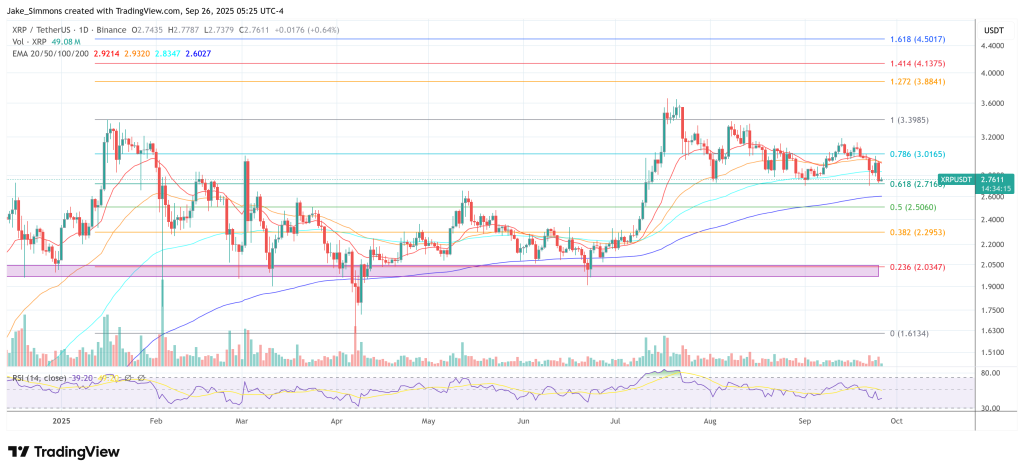
At press time, XRP traded at $2.76.