

The Markets in Crypto-Assets (MiCA) is a regulatory framework established by the European Union. It aims to standardize and supervise the digital asset market in the EU, creating a uniform regulatory approach across the EU. The regulation covers various digital assets, including stablecoins, and sets out rules for their issuance, trading, and custody.
While MiCA isn’t the first broad crypto regulatory framework in the EU, it’s the first one that specifically targets the fast-growing DeFi market in the region. The regulation has “extraterrestrial scope,” which means that it applies not only to EU member states but also to all businesses providing services to customers in the EU and to any businesses providing services using the Euro.
Although full implementation isn’t anticipated until December, MiCA’s impact is already noticeable in the global crypto market as stablecoin legislation went live at the end of June. As it applies to companies and exchanges headquartered outside of the EU, which constitutes a notable part of the global market, companies are already adjusting to the new reality of providing services in the EU.
The increased regulatory pressure in the United States has also affected the global market. With digital assets, especially Bitcoin, slowly becoming a new political frontier ahead of the 2024 Presidential elections, the political and regulatory uncertainty has put companies and exchanges in the country on edge.
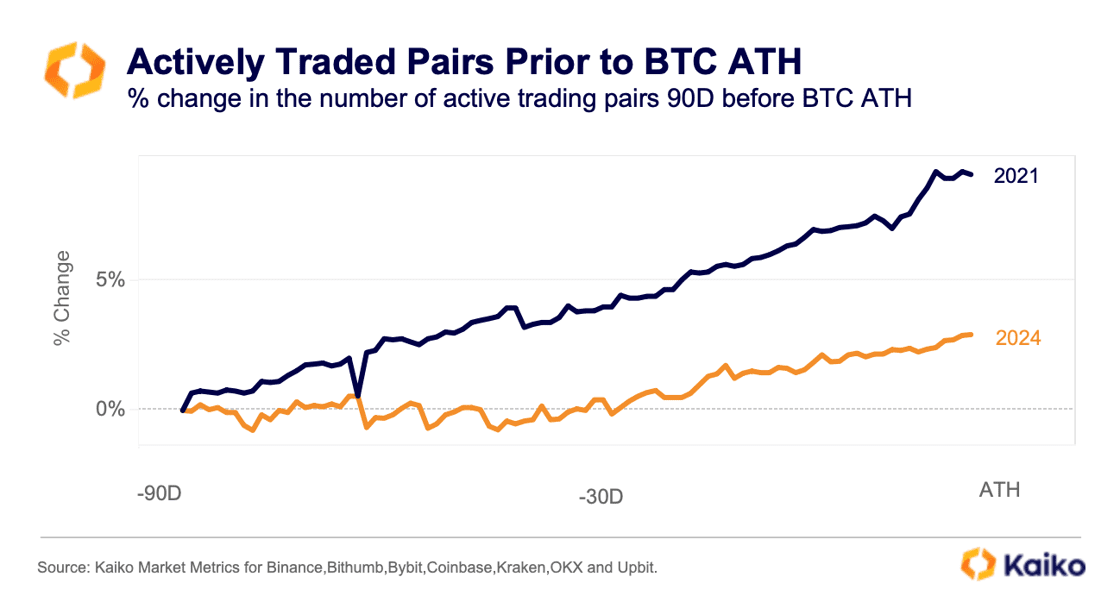
Data from Kaiko showed a noticeable shift in the rate of new exchange listings, showing companies around the world are becoming more cautious.
Crypto exchange listings have slowed down significantly since the peak of the 2021 bull run. This slowdown is evident in the reduced growth rate in new trading pairs across major exchanges providing services to customers in the EU and US. Kaiko’s data found a decline from a 9% growth rate before Bitcoin’s ATH in 2021 to just 3% before its 2024 peak.
Diving deeper into the data reveals exchange-specific trends. The number of active trading pairs on Binance has increased at a slower pace compared to other exchanges and remains 14% below its 2022 peak. While a significant part of Binance’s slowdown can be attributed to MiCA, the exchange has been experiencing a global slowdown in the past few months. The regulatory troubles the exchange has faced in various countries around the world, coupled with the charges against its founder and CEO, Changpeng Zhao, have also contributed to this. The legal troubles Binance.US faced last year also played a massive part in reducing its global dominance.
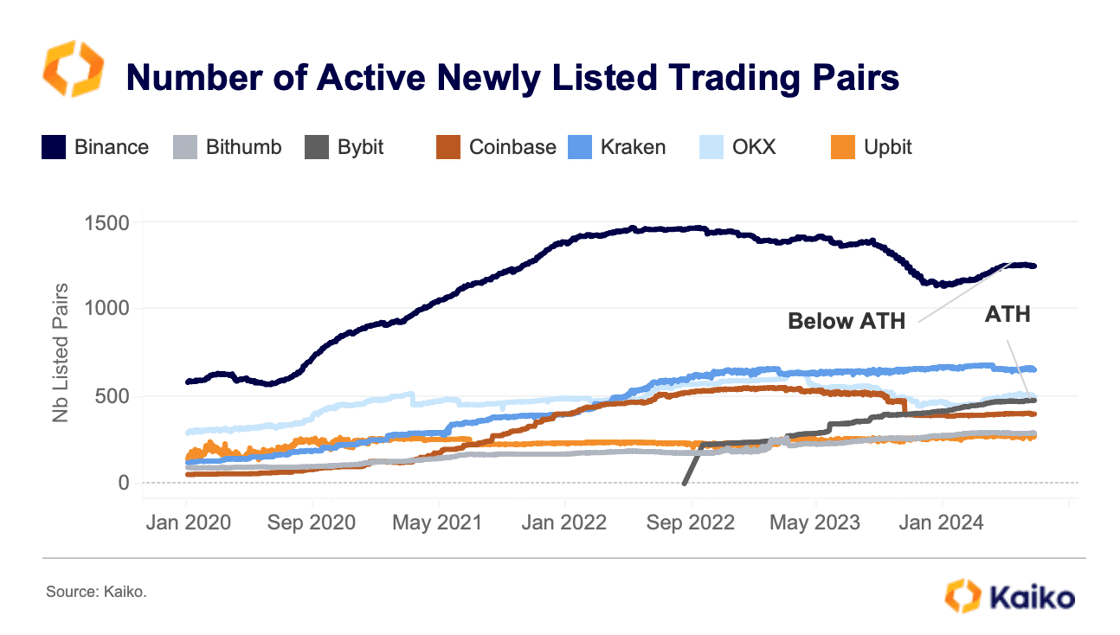
In contrast, Bybit has seen a surge in active trading pairs, reaching an ATH during the market rally we saw in May. Most of Bybit’s customers come from countries outside of the EU, which is why the company seems largely unaffected by MiCA. The same trend is seen in Korean exchanges, especially Bithumb, all of which have experienced rapid growth in new listings. New listings on Bithumb have outpaced Upbit, which led to increased regulatory attention in the country whose authorities are still struggling to introduce a comprehensive regulatory framework to the industry.
The slow rate of new listings and the shift towards stablecoin pairs have contributed to a deceleration in the overall growth of the crypto market. Emerging markets, however, are showing resilience and increased demand for cryptocurrencies, driven by factors such as inflation, currency volatility, and a lack of strict regulation.
The post New exchange listings suffer due to regulatory pressure in EU appeared first on CryptoSlate.