

Galaxy Research’s latest brief argues that the “wealth channel” in the United States—the network of roughly 300,000 financial advisors overseeing about $30 trillion in client assets—is finally starting to open to crypto assets, with implications that are both mechanical and potentially transformative.
$600 Billion Could Enter The Crypto Market Soon
The crux of the thesis is arithmetic but not trivial: “If even a modest 2% allocation to bitcoin ETFs emerged across this channel, that would translate to roughly $600 billion in potential inflows,” the note states, adding that such a sum “is comparable to the entire global gold ETF market (~$472 billion) and more than 3x the US spot bitcoin ETF AUM (~$146 billion).”
The firm frames this as the moment crypto begins moving from retail-driven speculation toward advisor-led portfolio construction, as approvals, custody, and compliance guardrails converge inside the largest wirehouses and banks.
The catalyst, in Galaxy’s telling, is a series of platform-level access changes and infrastructure buildouts that remove long-standing bottlenecks. On October 10, Morgan Stanley “removed longstanding restrictions on crypto fund access for its financial advisors,” allowing proactive recommendations “to all clients across any account type.” Galaxy highlights the bank’s newest house guidance—“up to 4%” of portfolios in digital assets—as a conservative but meaningful signal that crypto is being slotted alongside established diversifiers.
The shift matters less as a branding exercise and more as a workflow change: when exposure becomes standard inside advisory toolkits, it can be modeled, rebalanced, and supervised under the same risk and suitability processes that govern equities, bonds, and alternatives.
The research brief stresses how the wealth channel’s internal approval machinery has been the real gating factor. Advisors “can only allocate to products formally approved by their firms,” and those approvals depend on “custody readiness, compliance frameworks, operational integration, and client suitability standards.”
Crypto has lagged not because advisors lack interest, Galaxy argues, but because “approval of crypto products has been especially cautious” amid volatility, evolving regulation, and a limited on-platform track record. That calculus is changing as banks build the “critical backbone” internally—trading, custody, and advisory systems that let them “offer secure, scalable crypto access through their wealth platforms.”
In the same vein, the note flags movement among the largest brand names in US asset management and banking. Vanguard—long the archetype of crypto skepticism—“is reportedly preparing to offer select third-party crypto ETFs to its brokerage clients,” a reversal Galaxy attributes to “strong client demand and a more supportive regulatory climate,” while noting that there is “not yet [a] specific timeline or which ETFs will be made available.”
Citi, for its part, “plans to launch institutional-grade crypto custody in 2026,” and JPMorgan “signaled that its clients will soon be able to trade bitcoin and other crypto assets,” albeit without in-house custody for now. Galaxy treats these moves less as isolated headlines than as evidence that banks intend to capture crypto flows “using their own integrated trading, custody, and advisory systems” to provide regulated access at scale.
Policy context also features in Galaxy’s analysis. The brief points to the recent executive order allowing 401(k) plans to include crypto as an option” as a legitimizing step that helps fiduciaries and compliance teams grow comfortable with the risk profile of digital assets inside retirement plans. While implementation ultimately depends on how plan sponsors interpret fiduciary obligations, Galaxy’s point is that headline regulatory posture is no longer exclusively restrictive—reducing a key narrative and operational headwind for wealth platforms.
Importantly, Galaxy situates the prospective 2% allocation within a broader spectrum of public guidance from prominent allocators over the past year. The firm notes that “BlackRock, Fidelity, Bridgewater’s Ray Dalio, and Ric Edelman have publicly suggested crypto allocations ranging from a conservative 1% to as high as 40% in aggressive scenarios.”
Within this range, Morgan Stanley’s “up to 4%” ceiling is neither fringe nor maximalist; it reads as a risk-budgeted sleeve for an asset class the bank now describes as “both a hedge against inflation and a long-term growth opportunity.” Galaxy extends the math: if average allocations across advised assets land closer to 1% than 2%, bitcoin ETF assets could still reach “$500 billion within a few years.”
The bottom line: If advisors can finally “integrate crypto directly into traditional balanced portfolios,” the firm concludes, the industry will likely look back on this period as the point “where crypto transitions from a niche investment to a standard portfolio component, alongside equities, bonds, and gold.”
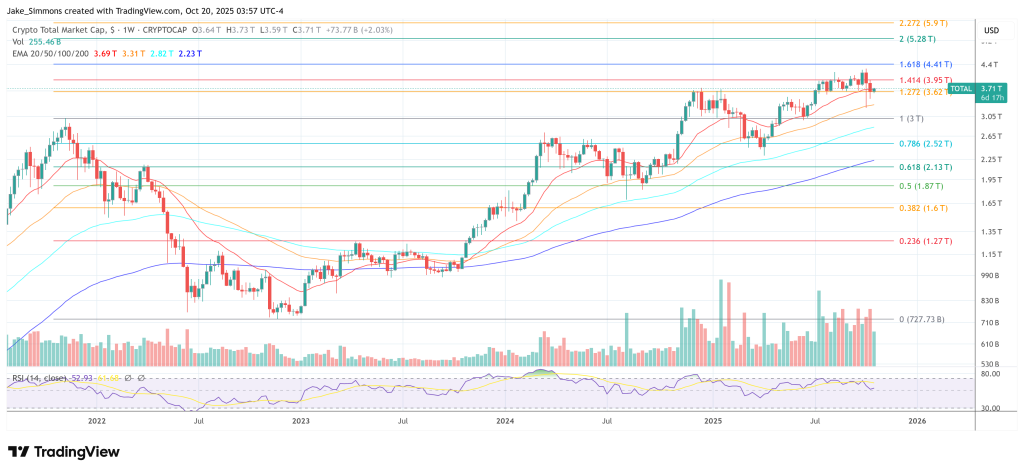
At press time, the total crypto market cap was at $3.71 trillion.