

In the latest issue of the “SHIB Magazine,” the Shiba Inu team has disclosed detailed plans for the upcoming hard fork of the Shibarium network, marking a pivotal milestone in the project’s ongoing efforts to enhance its blockchain infrastructure. This strategic upgrade is aimed at optimizing the network’s performance, increasing transaction processing speed, and preparing the infrastructure for future scalability and broader adoption.
The Shibarium hard fork encompasses a comprehensive upgrade focusing primarily on two core components of its blockchain ecosystem: Bor and Heimdall. These components are crucial for the network’s operation, with Bor functioning primarily as the block producer layer by facilitating the production of blocks in a manner similar to Ethereum’s Layer 1, and Heimdall acting as the validator layer that manages validator committees and stake delegation.
Shiba Inu Team Reveals Two-Phase Strategy
Scheduled for implementation in two phases, the Shibarium hard fork aims to address several key areas:
Phase One – Bor Hard Fork: Slated for today, May 2nd at 2:30 AM EST at a specific block height of 4,504,576, this update targets the Bor layer of Shibarium. It includes critical proposals such as an increase in the calculation of state sync confirmations and a new mechanism to introduce a delay of 128 seconds on state sync confirmation to mitigate issues arising from network partitions.
This issue has been observed when reorg lengths exceed the sprint length, affecting the calculation of state sync events which could potentially lead to errors in node synchronization. The modifications proposed are designed to dynamically calculate state sync parameters to ensure consistency and stability across the network.
Phase Two – Heimdall Hard Fork: Scheduled for the following day, May 3rd at 12:30 AM EST at block height 3,941,864, this update focuses on the Heimdall layer. It introduces mechanisms aimed at achieving deterministic finality in the network, a significant enhancement that ensures the reliability and immutability of transactions once they are confirmed.
The overarching goal of these upgrades is to significantly enhance the network’s efficiency and scalability. By streamlining the consensus mechanisms and optimizing the underlying infrastructure, the hard fork is expected to reduce transaction processing times, decrease transaction costs, and enable the network to handle an increased volume of transactions.
These improvements are critical as they contribute to making the network more accessible and cost-effective, which is particularly important for maintaining competitive edge in the rapidly evolving blockchain ecosystem.
From a technical standpoint, the upgrades to Bor and Heimdall are expected to involve enhancements to state sync mechanisms and consensus algorithms, which are vital for maintaining network stability and security. These enhancements are geared towards rectifying existing network issues and laying the groundwork for future advancements of Shiba Inu.
Moreover, the integration of features from Ethereum’s Shanghai upgrade into Shibarium underscores a strategic alignment with industry standards and best practices, enhancing interoperability with Ethereum-based applications and protocols. This move is anticipated to not only improve the technical robustness of Shibarium but also broaden its appeal and usability across a wider range of blockchain applications.
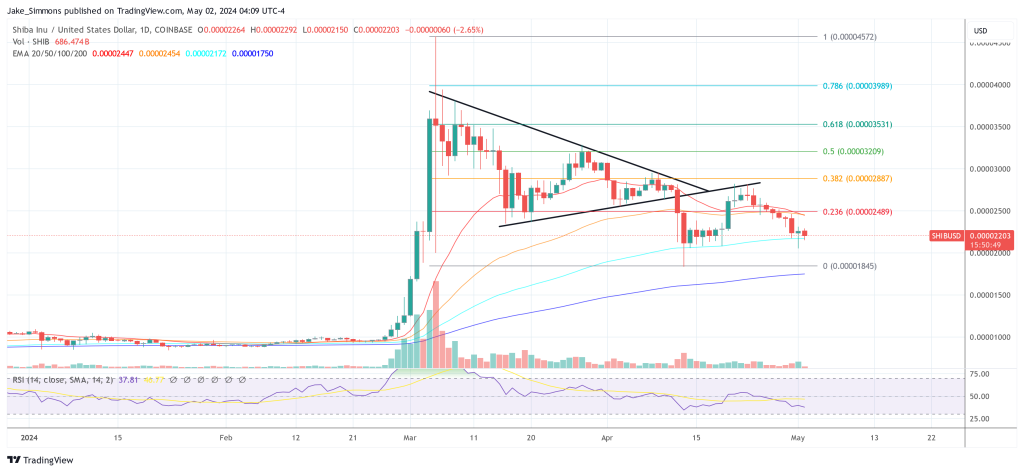
At press time, Shiba Inu (SHIB) traded at $0.00002203.