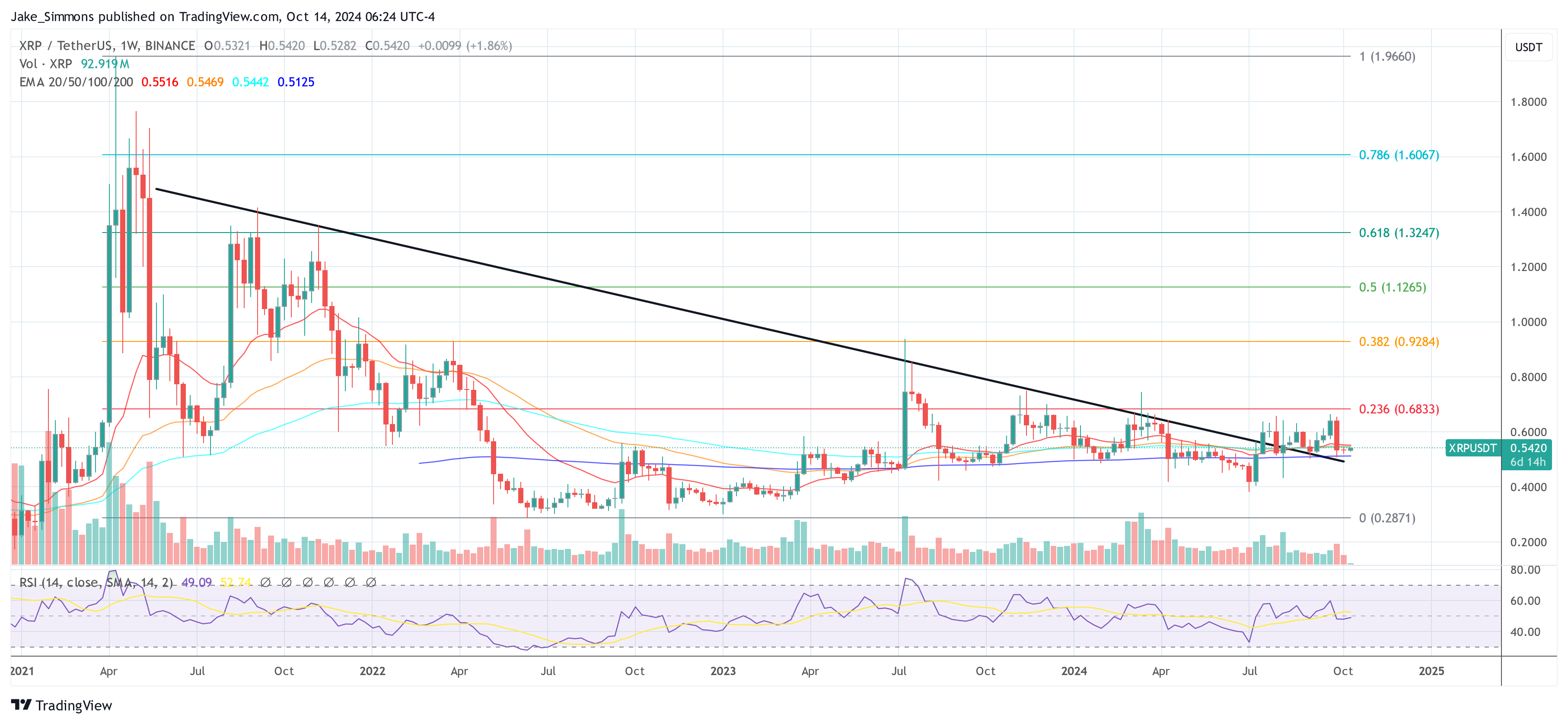
XRP has been one of the underperformers in the current crypto market cycle, remaining approximately 86% below its all-time high of $3.84 reached on January 4, 2018. Remarkably, despite significant fluctuations in the meantime, XRP is trading at a price similar to where it was one two years ago in October 2022. Crypto pundit known as CryptoTank (@Tank2033js) shared an explanation on X to clarify why the XRP price isn’t moving as some might anticipate. With 214,000 views, the thread gained a lot of attention.
Why Is XRP Price Stagnating? When Will It Change?
“I’m getting a lot of comments about XRP price and why it’s not moving,” began CryptoTank. “Let me explain once more how XRP price is determined for the new people to this space and those that still have trouble understanding.”
According to his analysis, the price of XRP is calculated by dividing the value or volume transacted on the XRP Ledger (XRPL) by the circulating supply of XRP. However, he emphasizes that the commonly referenced circulating supply figure of approximately 56 billion XRP is misleading. “Just because 56 billion is in circulation, it does not mean that the whole 56 billion is on the ledger for use,” he noted. A significant portion of XRP is held in private wallets, by large holders known as “whales,” or stored on exchanges, and thus not actively participating in daily transactions on the ledger.
“What matters for price is how much of that supply is active on the ledger,” he asserts. Estimating that about 20% of the circulating supply is active daily, he suggests that around 10 billion XRP are in use within the ledger’s ecosystem. This active supply is crucial for providing liquidity in Automated Market Maker (AMM) pools, which facilitate transactions by pairing XRP with other tokens or currencies such as RLUSD (Ripple USD).
He explains that banks and financial institutions planning to use the XRPL for settlements will operate with their own tokens or central bank digital currencies (CBDCs), pairing them with RLUSD and utilizing the liquidity available in the AMM pools. The XRPL employs an algorithm designed to find the most efficient path for settlements, defaulting to XRP as the primary source unless an alternative offers a better route. “This algorithm uses XRP as the default source of settlement and will only use something else if it’s better than XRP, which most likely won’t be the case,” he elaborates.
To illustrate the potential magnitude of value transacted on the ledger, CryptoTank highlighted the daily settlement volumes of several major financial institutions. SWIFT, the global provider of secure financial messaging services, processes approximately $5 trillion in daily settlements. J.P. Morgan Chase, one of the largest banking institutions in the United States, handles around $10 trillion daily. Bank of America processes about $7 to $8 trillion each day, and SBI Holdings in Japan settles approximately $2 trillion daily. “That’s about $25 trillion daily in settlement with just four banks/institutions,” he points out.
Moreover, Ripple, the company behind XRP, reportedly has over 1,700 non-disclosure agreements (NDAs) with various banks and financial institutions, suggesting a vast network of potential users for the XRPL. By conservatively assuming that only 10% of the settlement volume from these four institutions moves onto the XRPL, he estimated an on-ledger transaction volume of $2.5 trillion daily. To ensure smooth and frictionless transactions without failures—a critical requirement for banks—the liquidity in the AMM pools would need to be substantial. “These pools have to be about double the $2.5 trillion value to avoid failed transactions and friction within the pools. Banks cannot have failed transactions,” he stressed. This means that the total value or volume on the ledger would need to be approximately $5 trillion to accommodate the settlements efficiently.
Using these figures, he calculates the necessary price of XRP to facilitate this level of daily settlement. “To determine the price XRP needs to be to avoid friction and have deep enough liquidity pools to settle without failure between different currencies or CBDCs, you take the $5 trillion and divide it by the 10 billion of XRP in the pools,” he explains. This calculation yields a required XRP price of $500. “XRP’s price would need to be $500 to facilitate settlement daily,” he emphasizes.
“This is a very basic example of what will happen when these banks start using XRP daily for settlement,” he adds. He acknowledged that other factors could further enhance the value on the ledger, such as the tokenization of assets, debt, and real estate. “There are other factors like tokenized assets, tokenized debt, tokenized real estate, etc., that will all add value to the ledger in the future,” he notes.
Addressing skeptics who doubt the potential for XRP to reach such high valuations, he states: “For anyone saying XRP will never be a high price, you really don’t understand what XRP is going to be used for or how it works. Retail doesn’t matter, market cap doesn’t matter, charts are nice to look at but don’t matter either.” He argues that traditional metrics used to assess cryptocurrency value are less relevant in the context of XRP’s intended utility for institutional settlements.
“You can’t chart how much liquidity or depth of AMM pools will be needed to handle the settlement of those 1,700+ NDAs on a daily basis,” he contends. “Nobody has any clue how high that number will be. XRP must be a high price or it won’t work efficiently to do what it was designed to do, which is handle large transactions fast and cheap.”
However, not everyone in the crypto community agrees with his assessment. A user representing chart analysts on X responded to his thread, stating: “Wrong: The chart is the only thing that matters. Buy coins based on chart technical analysis and you do a lot better than buying narratives and hoping for it to pump. That’s why 99% of retail fails. Sad but true.”
In response, CryptoTank defended his position, emphasizing the impending shift in the crypto landscape due to institutional adoption. “You clearly have no idea how utility tokens work or what is about to take place globally in this space,” he retorted. “Soon retail speculation will be dwarfed by institutional adoption and usage. 99% of coins will become obsolete. The big money is coming into the game and everything will change.”
At press time, XRP traded at $0.542.