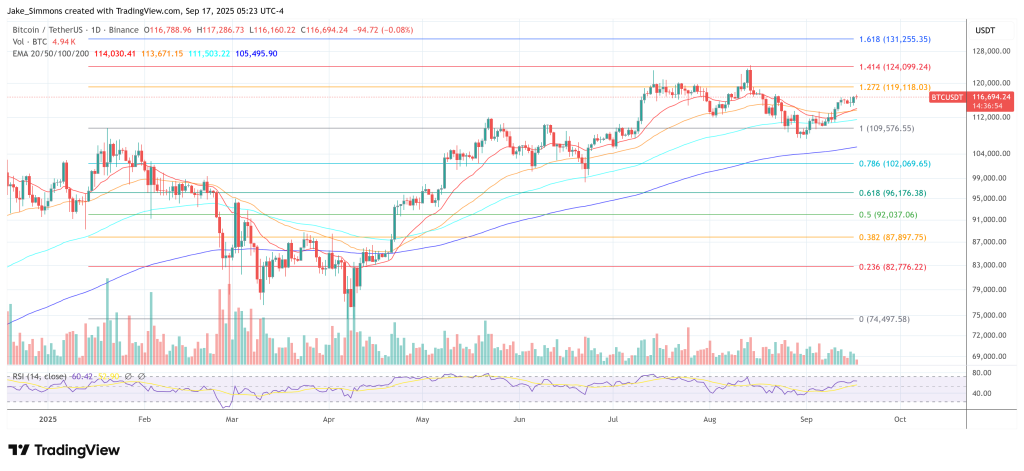


Arthur Hayes believes the macro domino that sends Bitcoin to $1 million has just tipped. In a post on X late Monday, the BitMEX co-founder argued that the US Federal Reserve is preparing markets for “yield curve control” (YCC) under what he called a “third mandate,” pointing to the confirmation of economist Stephen Miran to the Fed’s Board of Governors and a fresh Bloomberg report raising the same specter.
“With Fed board member Miran now confirmed, the MSM is preparing the world for the Fed’s ‘third mandate’ which is essentially yield curve control. LFG! YCC -> $BTC = $1m,” Hayes wrote. His comment came hours after Bloomberg published “Fed ‘Third Mandate’ Forces Bond Traders to Rethink Age-Old Rules,” which frames the possibility that the Fed will more actively shepherd long-term rates as part of its statutory goals.
Miran’s arrival at the Board is no longer hypothetical. He was narrowly confirmed by the US Senate and sworn in ahead of this week’s policy meeting while simultaneously the broader political fight over the central bank’s independence is flaring up.
The crux of Hayes’s claim is that the Fed’s oft-described “dual mandate” is, in fact, three-part, and that emphasizing “moderate long-term interest rates” could lead policymakers toward direct control of the yield curve. That wording is not a meme; it is statutory. Under 12 U.S.C. § 225a, Congress instructs the Fed to promote “maximum employment, stable prices, and moderate long-term interest rates,” a formulation also reflected on the Fed’s own website.
What Yield Curve Control Means For Bitcoin
On X, several market voices quickly co-signed the framing. Bitwise CIO Matt Hougan simply replied, “Agree.” Macro investor Lawrence Lepard reacted, “Wow! Miran saying the quiet part out loud!” Others noted they’ve been flagging the “third mandate” for months.
Mel Mattison highlighted the statute in June, writing that keeping the long end “moderate” is “just as much part of their mandate as are price stability and unemployment,” and argued that in a conflict of goals—as during Covid—policymakers could “sacrifice one to get two,” i.e., use balance-sheet tools to stabilize the long end and employment even if it risks higher inflation. His point underscores the operational hinge in Hayes’s thesis.
What YCC would mean in practice is contested but conceptually clear. Unlike standard QE—which sets a purchase size and lets yields float—YCC targets specific yields on medium- or long-dated Treasuries, enforcing caps with unlimited buying if needed. The St. Louis Fed describes YCC as “imposing interest rate caps on particular maturities,” a framework seen in Japan since 2016 and, briefly, in Australia. Such a regime would aim to arrest disorderly jumps in long rates that complicate debt service and risk transmission; critics view it as a soft form of financial repression with inflationary tail risks.
Hayes has tied this macro lever to an extreme Bitcoin upside for years. In 2022 he wrote that “YCC = $1mm BTC,” a refrain he revived in 2023 and again today. The logic is straightforward in his telling: if the Fed caps long-term yields while fiscal deficits remain wide, real yields are suppressed and fiat debasement accelerates, directing marginal flows into hard-cap assets like Bitcoin. Whether that causal chain unfolds is an open question, but the call is consistent with his prior essays and public posts.
Bloomberg’s piece did not declare YCC policy imminent; instead it documented how traders are re-pricing duration risk in light of Miran’s remarks about “moderate long-term interest rates” and the political context surrounding the Fed.
Still, the statutory anchor gives the “third mandate” narrative more than rhetorical weight. As the Fed convenes its September meeting—with a rate cut widely anticipated and the Board’s composition in flux—debate over whether the institution will ultimately be pushed from guidance to control on the long end has moved from fringe threads into mainstream coverage.
For Bitcoin, Hayes argues that merely acknowledging that path is the “trigger.” For markets more broadly, the stakes lie in whether managing the curve becomes a policy choice—or a policy necessity.
At press time, BTC traded at $116,694.