

The Bank of England (BOE) has published the highly anticipated consultation paper on its proposed regulatory regime for stablecoins, set to be implemented in the second half of next year.
BOE Moves Forward With Stablecoin Holding Limits
On Monday, the Bank of England released a new consultation paper on its proposed regulatory framework for sterling-denominated systemic stablecoins, addressing backing rules and holding limits.
The BOE’s new framework is built on feedback received on the November 2023 Discussion Paper, reflecting the Bank’s efforts to draft “robust, future-proof” rules that are aligned with the regulator’s strategy to modernize UK retail payments.
Notably, the Bank has moved forward with a controversial proposal to cap stablecoin ownership to “mitigate financial stability risks stemming from large and rapid outflows of deposits from the banking sector.”
As reported by Bitcoinist, the central bank has been exploring restrictions on stablecoin ownership in the country for months, seeking to impose limits of £10,000 to £20,000 for individuals and £10 million for businesses. The plan resembles its proposed approach to the digital pound, also aimed at addressing financial stability risks.
Some crypto industry and payment groups heavily criticized the central bank’s proposal, arguing that it would put the UK at a disadvantage against the US and the European Union (EU).
Following the backlash, news media outlets reported that the BOE was exploring granting exemptions to businesses that need to hold large amounts of stablecoins, like crypto exchanges.
The consultation paper confirmed the holding limits proposal “to safeguard continued access to credit as the financial system gradually adapts to new forms of digital money.”
However, it clarified that the limits would be “temporary” and would be removed “once the transition no longer poses risks to the provision of finance to the real economy.” It also noted that an exemption regime will allow the largest businesses to hold more stablecoins if required.
New Regime Eyes Joint Regulatory Approach
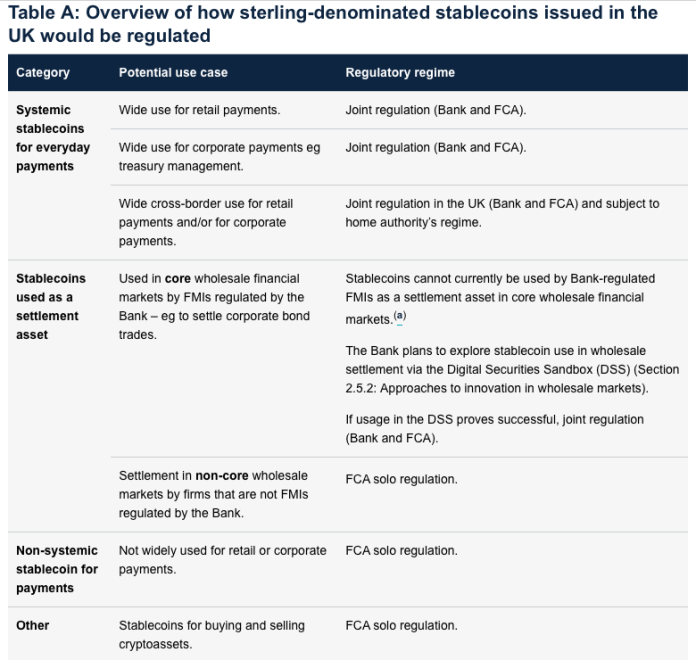
As the announcement explained, the regime will only apply sterling-pegged stablecoins. Meanwhile, stablecoins used for non-systemic purposes, such as the buying and selling of crypto assets, will be supervised by the Financial Conduct Authority (FCA).
The BOE unveiled a joint regulatory approach with the FCA, with a document clarifying how rules will apply in practice set to be published in 2026. “If recognised as systemic by HM Treasury (HMT), they will transition into the Bank’s regime and will be jointly regulated, with the Bank overseeing prudential and financial stability risks, and the FCA continuing to supervise conduct and consumer protection,” the Bank detailed.
Among the key policy proposals covered in the consultation paper, the Bank suggested that systemic stablecoin issuers be allowed to hold up to 60% of backing assets in short-term UK government debt.
The BOE will provide issuers with unremunerated accounts at the Bank for the remaining 40%, aiming to ensure “robust redemption and public confidence, even under stress.”
Additionally, issuers considered systemic at launch or transitioning from the FCA regime will initially be able to hold up to 95% of their backing assets in short-term UK government debt to support viability as they grow.
A new policy also proposes central bank liquidity arrangements to issuers in times of stress, reinforcing financial stability by “providing a backstop should systemic issuers be unable to monetise their backing assets in private markets.”
Sarah Breeden, Deputy Governor for Financial Stability, affirmed that the BOE’s objective “remains to support innovation and build trust in this emerging form of money.”
“We’ve listened carefully to feedback and amended our proposals for achieving this, including on how stablecoin issuers interact with the Bank of England. These proposals are fit for a future where stablecoins play a meaningful role in payments, giving the industry the clarity it needs to plan with confidence,” she concluded.