

Ripple and XRP were thrust into the spotlight after SWIFT chief innovation officer (CIO) Tom Zschach delivered a pointed critique on LinkedIn—widely read as a jab at the company and its XRP token—over what actually constitutes “resilience” for banks and how institutional trust is earned.
The exchange began under a comment praising Ripple’s regulatory endurance, where Zschach countered bluntly: “Surviving lawsuits isn’t resilience. Neutral, shared governance is. Institutions don’t want to live on a competitor’s rails.” He followed by rejecting the notion that a single firm’s rapport with watchdogs equals compliance, writing: “And compliance isn’t about one company convincing regulators it should be allowed to operate. It’s about an entire industry agreeing on shared standards that no single balance sheet controls.”
Ripple Vs. SWIFT
Zschach then broadened the frame in a longer post about how banks actually adopt technology. “Every major shift in finance begins the same way. Technology lays the foundation but trust decides when the building opens.”
He recalled that previous “next big things” in finance stalled not on throughput, but on the absence of compliance and security. The parallel he drew to public blockchains in 2025 was explicit: they are becoming too consequential to ignore—“Tokenized treasuries. Collateral on-chain. Cross-border payments that actually settle”—yet raw technical performance is not the finish line.
They think the public chain itself is the solution. It isn’t,” he argued, calling public networks “the base environment for execution,” powerful for deterministic, programmable settlement but insufficient without the “trust layer” of legal enforceability, compliance, and privacy. Without that layer, he warned, a public chain is “a fast engine with no cockpit.”
Crucially, Zschach’s critique drew a governance boundary that cuts to the heart of Ripple’s pitch to banks without naming the company. He re-centered the conversation on neutrality and shared control, rather than on the courtroom durability or regulatory narratives of any single firm. In his words, institutions want “shared standards that no single balance sheet controls,” and they will resist depending on “a competitor’s rails.”
He extended the caution to consortia as well: “If a bank joins a chain owned or controlled by another bank then they are accepting someone else’s governance, incentives and rules of the game. In today’s environment is that a form of dependency that banks will be comfortable with?” The throughline is that institutional adoption hinges less on whether one vendor has outlasted enforcement actions and more on whether the infrastructure is credibly neutral, co-governed, and enforceable in law.
Zschach’s taxonomy of public chains as “substrate” underscores how he expects the industry to evolve. In biology, computing, and construction, a substrate is foundational; what matters for banks is what gets layered above it. He urged builders not to “fight the public chains” but to harness them while solving for compliance from day one and for privacy “without killing transparency.”
That is where he believes the “opportunity lies,” with finance ultimately “absorbing the best of public chains on its own terms.” The open question he posed back to the market—“When will banks and financial institutions truly trust public blockchains and at what pace will that trust build?”—puts the burden of proof on governance design and standards alignment, not on marketing milestones.
For Ripple and XRP, the implication is clear even if Zschach never typed the name in his critique: the bar for bank adoption isn’t surviving litigation or securing green lights for a specific product stack; it is convincing the industry that the rails they ride are neutral, shared, and not controlled by any single company’s balance sheet (like Ripple’s escrow still controlling more than 35% of all XRP). In that lens, resilience is measured in how power is distributed, how rules are enforced, and how privacy and compliance are engineered—precisely the dimensions Zschach says decide “when the building opens.”
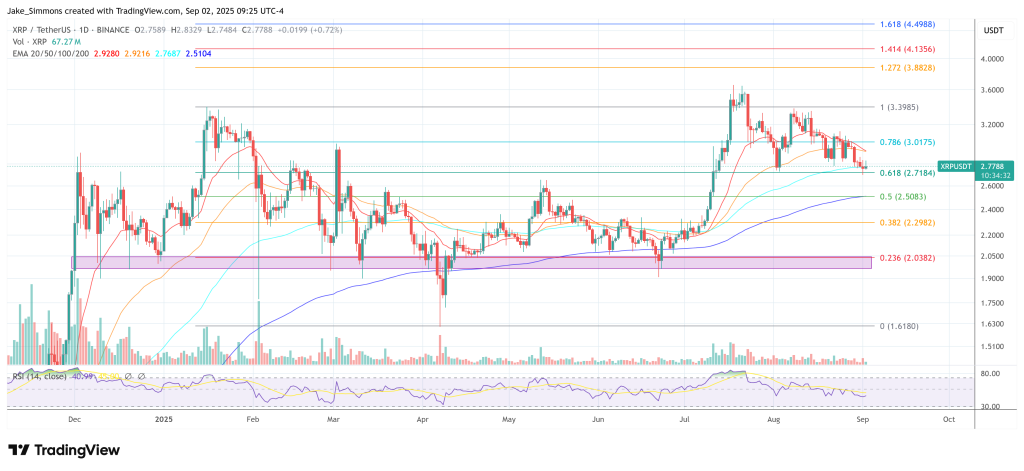
At press time, XRP traded at $2.77.