

Bitcoin’s volatility hits new lows during prolonged market consolidation

Share This Post

Quick Take

Glassnode defines realized volatility as the standard deviation of returns from the mean return of a market, indicating market risk. High values signal high-risk phases. Unlike implied volatility, which predicts future market volatility, realized volatility measures past market fluctuations. Calculated based on daily returns and annualized, it offers insight into market behavior over rolling windows of various durations: 1 week, 2 weeks, 1 month, 3 months, 6 months, and 1 year.

The chart illustrates that annualized realized volatility for Bitcoin has trended downwards since its March peak. Specifically, the 1-week, 2-week, and 1-month volatilities have decreased from around 60% to approximately 30%. Historically, high volatility rates coincide with significant market events, such as the 2017 peak, the September 2019 bottom, the mid-cycle top in July 2019, and the 2021 peak. Despite these fluctuations, the overall trend shows a decline in volatility, according to Glassnode data.
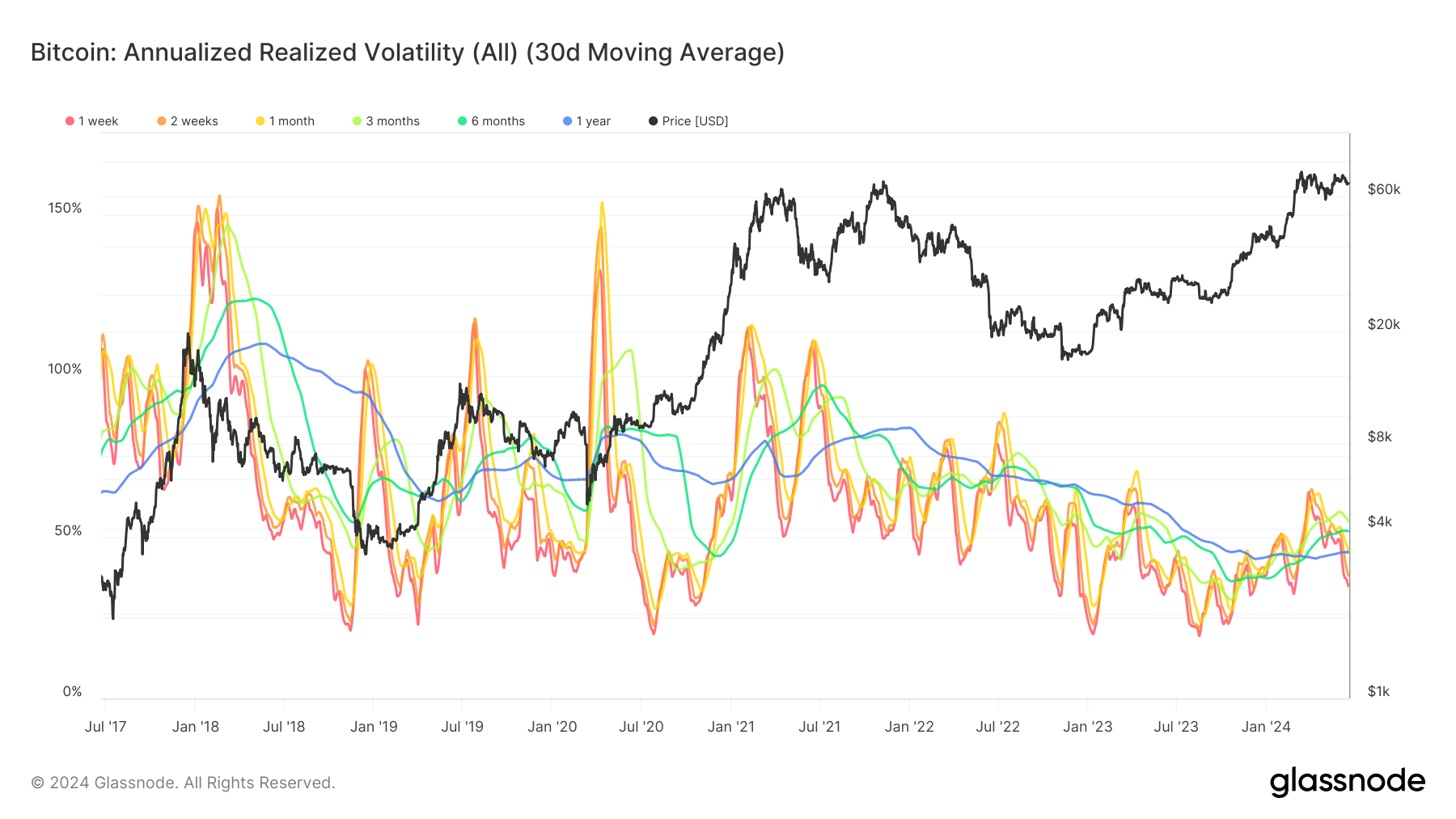
Annualized Realized Volatility: (Source: Glassnode)

The current low volatility can be attributed to Bitcoin’s ongoing consolidation phase. Notably, Bitcoin has been consolidating in the previous all-time high (ATH) region for 3.5 months, marking the most extended period of sideways movement around a previous cycle’s ATH, according to an anonymous X account, Daan Crypto Trades.

Daan Crypto Trades highlights this extended consolidation, contrasting it with the quicker consolidation period in 2020, which lasted just 3-4 weeks. This prolonged sideways movement emphasizes the current stability and reduced volatility in the Bitcoin market.

“Currently we’re on our longest sideways chop around a previous cycle’s all time high. 2020 was the quickest and took just 3-4 weeks”.


BTCUSD: (Source: @DaanCrypto)

The post Bitcoin’s volatility hits new lows during prolonged market consolidation appeared first on CryptoSlate.


Read Entire Article
spot_img
- Advertisement -spot_img

Related Posts

US Launches Pax Silica: Global AI Supply Chain Security Initiative

United States convenes strategic partnership with eight key nations to secure and innovate critical technology ecosystems for the AI era The United States launched the Pax Silica strategic

Capital A, Standard Chartered Malaysia Team up to Explore Ringgit Backed Stablecoin

Capital A and Standard Chartered Bank Malaysia have signed an agreement to explore developing and testing a ringgit‑denominated stablecoin within Bank Negara Malaysia’s Digital Asset Innovation

Robinhood is constructing a “regional triangle” that unlocks the one thing US regulators won’t permit

Robinhood has spent the past few years trying to outgrow its meme-stock reputation, and the clearest sign that it is thinking differently now sits far from Menlo Park In early December, the company

Here’s What Could Happen if XRP ETFs Reach $10 Billion

The post Here’s What Could Happen if XRP ETFs Reach $10 Billion appeared first on Coinpedia Fintech News Interest in XRP exchange traded funds is growing quickly after another product received

Render Network Targets Cloud Bottlenecks With Distributed GPU Platform

The Render Network Foundation has launched Dispersed, a distributed GPU computing platform aimed at easing growing constraints in centralized cloud infrastructure as global artificial intelligence

Bitcoin Takes Backseat As Treasury’s Cash Flow Becomes Must-Watch Chart – Here’s Why

Bitcoin has been the undisputed dominant force in the financial world In a swift change of financial gravity, the spotlight has shifted from the decentralized digital asset to the US government