

The Cardano Foundation is preparing to apply for two generic top-level domains—“.ada” and “.cardano”—in the next ICANN application round, positioning the network’s brand and identity closer to the core addressing layer of the web.
In a forum announcement dated 21 October 2025, the Foundation said it intends to submit applications in Q1 2026 and will finance the effort entirely from its own resources, not the Cardano Treasury. “The Cardano Foundation plans to apply for the registration of the .ada and .cardano gTLDs,” the post states, adding that the initiative has been scoped since 2023, when ICANN signaled a new application window for gTLDs.
Cardano Aims For Its Own Corner Of The Web
The move would bring Cardano into a relatively small cohort of blockchain ecosystems that control their own top-level namespace rather than relying solely on third-party registries or Web3-native naming systems. The Foundation frames the applications as both defensive and strategic: securing Cardano-specific string(s) should reduce the risk of brand misuse while creating an on-ramp for identity and interoperability features that bridge Web2 and Web3.
If approved, these domains would function like any other gTLD, meaning ecosystem participants could register second-level names such as “vespr.ada” or “nmkr.cardano,” with the registry operated under policies the Foundation says it will publish and report on regularly.
Beyond brand control, the Foundation emphasizes potential product-level integrations. It explicitly highlights “simplified wallet addresses,” integration with decentralized identity solutions “like Veridian,” and even “domain tokenisation” as areas it wants to explore.
The post also notes active conversations “with Ada Handles and Handshake to explore use cases that bridge traditional DNS and Cardano.” These examples suggest the registry could serve as an anchor for human-readable identifiers that resolve to blockchain credentials, payment endpoints, or verifiable credentials, all within the governance and security constraints of ICANN’s DNS.
The Foundation says a multi-disciplinary team has been shaping the plan, including consultations with community experts and vendor evaluations for both the application process and future registry operations. Operationally, it proposes a Community Advisory Group to guide policy and development, and commits to “regularly publishing figures on the gTLDs’ operation,” in line with its existing transparency reports.
It also floats the possibility that net returns, if any, could be funneled back into broader ecosystem work. While the post underscores that “there is no guarantee of success,” it argues the risk is justified by the strategic upside and the once-in-a-decade nature of ICANN’s application windows.
Financially, the Foundation provides an unusually detailed cost outline. It estimates one-time application costs of roughly $700,000 for the two strings, comprising approximately $500,000 in ICANN fees and $200,000 for application support. It then projects about $350,000 in annual fixed costs to operate the registries, split between ICANN fees and registry software/licensing on one side and marketing/business development/overhead on the other. Variable costs, such as per-domain operations, would depend on sales volume and are expected to be offset by domain revenue. The post reiterates, “The Cardano Foundation will cover all costs directly,” and “will not ask for Cardano Treasury funds.”
To surface sentiment and produce a public signal that can be cited in the application dossier, the Foundation has submitted an “Info Action” for community voting. It asks stake pool operators and DReps to support the measure, arguing that visible endorsement can bolster the credibility of a community-based application in ICANN’s review process. “Please cast your vote,” the statement urges, adding that, if the Info Action passes, the Foundation will proceed to file applications for both strings in Q1 2026.
As with most governance-adjacent proposals in Cardano, the plan has already prompted debate. In the same forum thread, a community member explained a “no” vote, citing concerns about Foundation governance and the concentration of influence, particularly after the Foundation’s heavy voting in Catalyst Fund 13.
The commenter wrote: “I voted no on this info action,” and argued that the “scale of CF’s voting power… undermined the principles of decentralised governance,” suggesting an independent, community-governed not-for-profit might be a better registrar. While a single post does not constitute a representative sample, it captures the contours of skepticism the Foundation may need to address which were fueled by IOG founder Charles Hoskinson in the past.
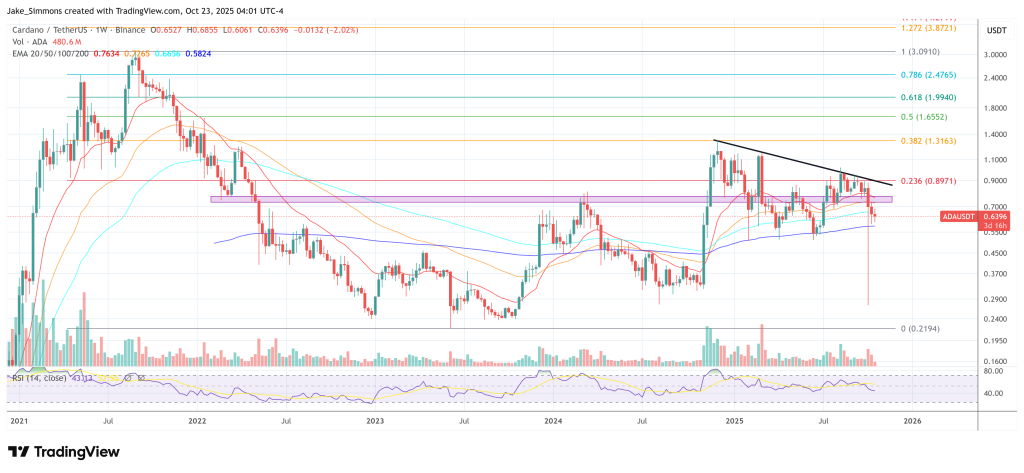
At press time, ADA traded at $