

Cardano Founder Charles Hoskinson delivered a keynote at Paris Blockchain Week on Wednesday. In his address, Hoskinson underscored the necessity of pushing blockchain into what he described as its “fourth generation,” a phase he believes will require forging cooperation among competing protocols rather than fomenting rivalry. He argued that only through inclusive, cross-chain collaboration can decentralized finance genuinely replace traditional structures.
Cardano’s Multi-Chain Future
Hoskinson captured the audience’s attention by announcing plans for an upcoming airdrop designed to distribute tokens to users of eight different networks. “So in the coming months, we’re gonna do an airdrop—37 million people in eight networks,” he said. “If you hold Bitcoin or Ether or Cardano or XRP […] Solana and a few others, you’ll get a drop. Everybody gets a taste.”
Elaborating on his long-term vision, Hoskinson traced the historical roots of cryptography and the emergence of Bitcoin as “the first generation” of blockchain, a breakthrough that took “30 years to resolve” as part of the cypherpunk movement. Yet he lamented that the space continues to grapple with centralization risks and regulatory uncertainties, citing financial crises and unpredictable economic policies as recurring arguments for “why we need blockchain and cryptocurrencies.”
He asserted that power should be decentralized, distributed to “the edges,” rather than concentrated in a small circle of economic actors. This will lead to boom in real-world assets: “About $10T to $13T will enter crypto from RWAs. Every RWA has a compliance regime. With privacy on-chain, settlement can be compliance. The 4th gen enables you to bridge TradFi and DeFi, making it just Fi. That’s the magic.”
Hoskinson further examined the limitations of today’s blockchain ecosystem and called for a new focus on privacy and identity, aspects he believes are integral to mainstream adoption. “If you have a restaurant, do you want the general public to know how much money is in the cash register?” he asked. “Privacy requires identity though, because you have built within it a disclosure regime to the tax authority, to the auditor, to your HR director—whoever it might be.” He argued that privacy must be “baked in” at the protocol level rather than handled by third-party servers, an approach he feels undermines decentralization.
That perspective led Hoskinson to describe the fourth generation of blockchains as a unifying model, one in which cooperation supersedes the hostility of competing protocols. He spoke about Midnight that aims to achieve interoperability across multiple chains, tackling compliance and privacy challenges without forcing users to switch from their existing networks. “We need to have chain abstraction so that people can use your things without moving the network effect. You can stay on Ethereum, Aptos, Solana, Bitcoin. You can just call into something, and it gives you those capabilities.”
Hoskinson explained that the underlying consensus protocol for Midnight, known as Minotaur, brings multiple networks into a shared security environment. “Minotaur brings all chains together. Is it Proof of Work? Proof of Stake? Proof of History? Actually it’s everything. It’s a multi-resource consensus protocol and pays block rewards to multiple networks at the same time,” he said, revealing an architecture designed to let Bitcoin miners, Ethereum validators, and other network participants secure the new system without abandoning their home chains.
The Cardano founder argued that this approach avoids “an intrinsically adversarial” scenario, suggesting that many of the inefficiencies within crypto arise from zero-sum thinking among token communities.
He closed by reflecting on the formidable competition that big tech firms—once armed with regulatory clarity—could present if they decide to “bundle” crypto wallets and services into their devices and platforms. “Does it make a lot of sense to pick a fight with a behemoth when they literally have trillions of dollars and armies of engineers?” he asked, pointing out that the only way forward is to build inclusive technologies that both encourage mass adoption and preserve decentralized values.
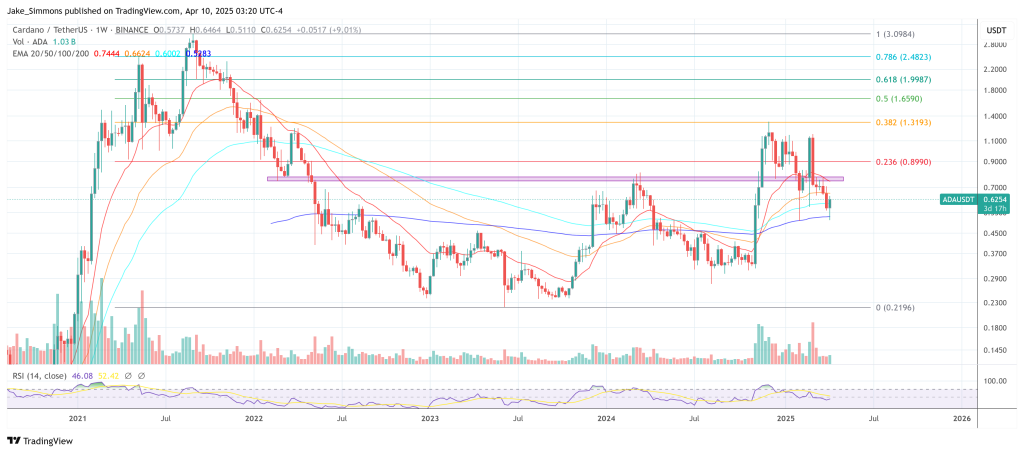
At press time, Cardano traded at $0.6254.