

Messari’s new comparative study sets two of crypto’s most talked-about networks side by side, measuring how successfully each is courting the next wave of enterprise capital and regulated finance. Chainlink, a decentralized oracle network built atop Ethereum, is framed as “a foundational connectivity layer that already underwrites more than $20 trillion in on-chain value,” while the XRP Ledger (XRPL) is cast as “a purpose-built settlement rail evolving toward full-spectrum institutional DeFi.”
Chainlink Vs. XRP Ledger
Chainlink’s value proposition is singular: secure, tamper-proof data delivery and cross-chain messaging for any smart-contract platform. Messari notes that its Cross-Chain Interoperability Protocol (CCIP) “is fast becoming the TCP/IP of tokenized finance,” and points to the October 2024 launch of the Chainlink Runtime Environment as a turning point. “CRE lets capital-markets engineers design bespoke oracle workflows without writing Solidity at all; that is gold dust for banks,” the report quotes a London-based fintech architect as saying. Development pace is equally striking. Over the past year Chainlink’s GitHub activity “frequently surpassed Ethereum core-protocol repos,” an achievement Messari attributes to the roll-out of CCIP v1.5, the network’s institutional sandbox, and the latest iteration of staking.
XRPL’s trajectory, by contrast, flows from payments into tokenization, then outward into regulated DeFi. Messari highlights the ledger’s decade-long record of sub-second settlement and its native decentralized exchange, but argues that “the existing Solidity code to an environment that settles in fractions of a cent.” Legal clarity matters as well. The report reminds readers that Ripple’s courtroom clash with the US Securities and Exchange Commission still drags on the network’s success.
Financial metrics underscore how differently the two ecosystems monetize traction. At roughly $10.35 billion in market capitalization, LINK commands only a third of XRP’s $34.82 billion valuation, yet the oracle token trades at $15.65—some twenty-five times more than XRP’s $0.63. Messari argues that the disparity reflects “structural divergence between a scarce middleware token valued like a SaaS utility and a high-velocity settlement asset priced for payments throughput rather than store-of-value appeal.”
Partnership momentum is where the lines truly begin to blur. Chainlink’s SmartCon 2024 disclosed integrations with 37 new blockchains and a string of proofs-of-concept with global custodians; still, Messari singles out one link-up above the rest: “Chainlink now supplies pricing oracles for Ripple’s incoming RLUSD stablecoin, a deal that dissolves the idea that the two projects exist in separate silos.” On XRPL’s side, the report flags the network’s Multi-Purpose Token standard, compliance hooks for know-your-customer checks, and rapid patching of an SDK vulnerability in April 2025 as signals that “institutional risk desks are finally willing to run production traffic through an open public chain.”
Regulatory posture remains an axis of comparison. Chainlink, lacking a payments layer of its own, has largely skirted securities scrutiny. Messari writes that “its biggest regulatory lift is proving the determinism of its oracle engine—so far, so good.” XRP Ledger, by contrast, “carries the scar tissue of the SEC’s enforcement era,” but the report argues that recent victories have turned that history into an advantage: “Few other networks can show investors a playbook for navigating hostile regulators and emerging with a settlement, market cap intact, and enterprise pipeline expanding.”
The conclusion resists coronating an outright winner. Chainlink, Messari says, “is cementing itself as the indispensable data and interoperability layer for tokenized finance,” whereas XRPL “is positioning to become the settlement and asset-issuance backbone for banks that must obey strict compliance regimes.” The most telling line in the report may be this: “The future of crypto infrastructure is collaborative, not competitive.” By supplying oracles for Ripple’s own stablecoin, Chainlink implicitly endorses XRPL’s settlement layer; by leaning on Chainlink’s feeds, Ripple concedes that institutional DeFi will require best-in-class middleware rather than closed-loop solutions.
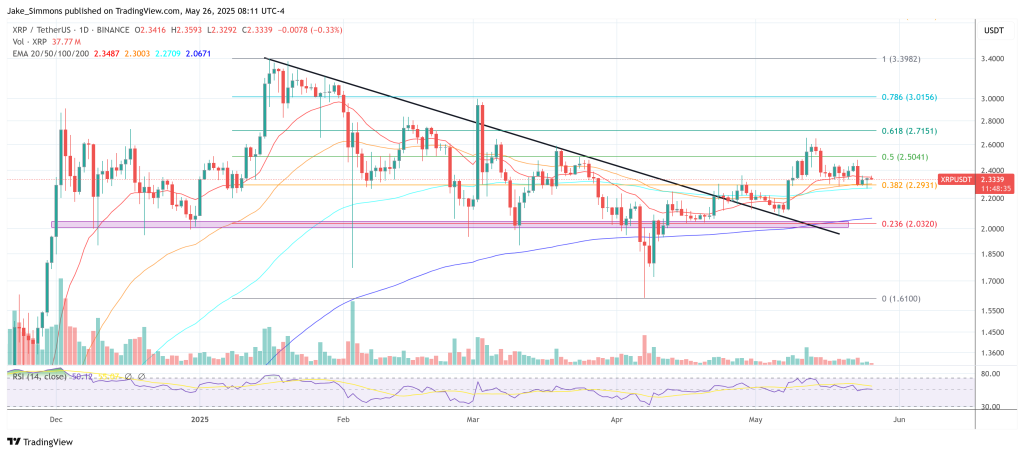
At press time, XRP traded at $2.33.