An obscure spread at the heart of US money markets just flashed a bright warning, and crypto traders are pouncing on the signal. The Secured Overnight Financing Rate (SOFR) printed 4.29% on Wednesday, while the Federal Reserve’s overnight reverse-repo (ON RRP) award rate sat at 4.00%, putting the SOFR–RRP spread at 29 basis points on a non-quarter-end day — an unusually wide gap that points to tightening funding conditions in the plumbing of the financial system. On the same day, the Fed’s Standing Repo Facility (SRF) was tapped for $6.5 billion — the largest non-quarter-end draw since its creation — as general collateral repo rates jumped, another sign of reserve frictions.
Why Crypto Bulls Smell Blood
The move has revived talk that the Fed’s quantitative tightening (QT) campaign is running into the same reserve-scarcity constraints that forced a policy pivot in 2019. “QT could be done by this October FOMC meeting at this rate,” On the Margin podcast host Felix Jauvin wrote on X, amplifying trader Sahil Mehta’s data point: “SOFR–RRP spread at 29bps on a random Wednesday.”
Head of Growth at Horizon and Theya Joe Consorti framed the market backdrop more bluntly: “Regional banks down 4.5%. Gold at $4,300/oz. SOFR/RRP spiking. Feels like a policy response is imminent.” Those remarks reflect a widening belief among macro-sensitive crypto investors that a liquidity backstop — whether an earlier-than-planned QT halt or stepped-up repo operations — could arrive as soon as the Fed’s October 28–29 meeting.
A parallel market message arrived from risk assets and havens. Gold ripped through $4,300 per ounce for the first time on Thursday, while US regional banks slumped anew — recording a 4.5%–7% drop in the KBW regional bank gauges amid loan-quality headlines and rising funding costs. Those moves reinforced the “tightening liquidity, rising stress” read that macro traders mapped onto the SOFR print.
Commentary on X pushed the narrative further. Analyst Furkan Yildirim argued the spread is “a classic sign of funding pressure,” adding that with the reverse-repo buffer depleted and QT ongoing, “fewer and fewer excess reserves in the system” mean “real liquidity scarcity,” especially around heavy Treasury issuance and tax days.
“What’s happening here is a classic sign of funding pressure, i.e., stress in the short-term money market. In other words: Banks and major financial players are struggling to find enough cheap money to refinance overnight. We last saw this in this form in 2019, shortly before the Fed was forced to pump liquidity back into the system,” Yildirim wrote via X.
Another account, @The_Prophet_, tied the move to a broader decoupling between market-based rates and the Fed’s administered corridor: “SOFR spiking above the Fed Funds rate means the interbank plumbing is tightening… The Fed will call it ‘technical.’ But history will call it ‘the moment control began to slip.’” While the rhetoric is charged, the underlying constellation — SOFR above EFFR, an elevated SOFR–RRP gap, SRF usage in mid-month — is the sort of micro-divergence that often precedes policy recalibration.
Policymakers themselves have been edging in that direction. After delivering a 25 bp cut on September 17 to a 4.00%–4.25% range, Fed officials have signaled openness to further easing, and market odds lean toward additional accommodation. Governor Christopher Waller on Thursday endorsed another 25 bp move at the October meeting, and Chair Jerome Powell has acknowledged tightening financial conditions and the approaching end of QT.
If the Fed does halt balance-sheet runoff this month, it would mirror the 2019 experience, when repo-market stress — SOFR briefly topped 5% and EFFR breached its target — catalyzed a fast operational pivot.
For crypto, the signal chain is straightforward even if the timing isn’t: persistent funding frictions beget official liquidity backstops; backstops relax financial conditions; and looser conditions have historically supported liquidity-sensitive assets.
The difference — as several macro voices cautioned — is that today’s spread isn’t euphoria, it’s strain. That nuance matters. A policy response that arrives under duress can buoy “number go up,” but it also speaks to fragility in the pipes that route collateral, cash and risk. Until the SRF usage recedes, SOFR re-anchors below fed funds, and the ON RRP buffer stops scraping the floor, the plumbing is telling you what the charts can’t: liquidity is getting dear, and the clock is running toward October 28–29.
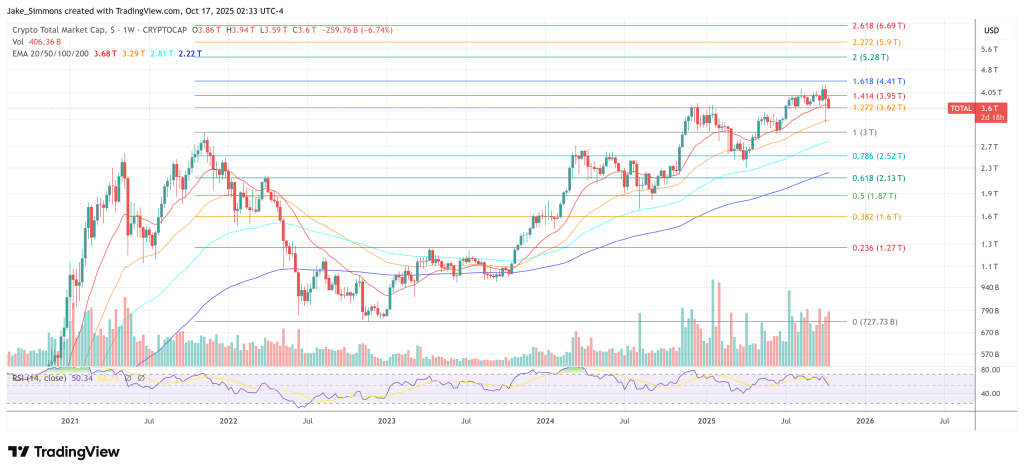
At press time, the total crypto market cap stood at $3.6 trillion.