

A viral thread on X (1.1 million views) has put forward a forensic narrative for Friday’s crypto wipeout, arguing that what looked like a chaotic macro-driven capitulation was, in fact, a targeted exploitation of how Binance priced collateral inside its Unified Account. The author @ElonTrades frames the episode not as a stablecoin failure but as an exchange-side design flaw that was hit precisely when the broader market was already on edge.
Why Did The Crypto Market Really Crash?
According to @ElonTrades, the core of the setup was Binance’s decision to value certain collateral — notably USDe, wBETH and BNSOL — using its own spot-order-book data rather than external or redemption-based oracles. The thread claims Binance had already announced a change “on Oct 6 … to move to oracle-based pricing,” but with rollout until Oct 14, leaving what the author describes as an eight-day vulnerability window.
In that window, the alleged exploiters could move the venue’s internal marks by shifting prints in local order books, instantly shrinking users’ borrowing power and setting off margin calls.
The Oct 11 Crypto Crash — What Really Happened
TL;DR:
Roughly $60–90M of $USDe was dumped on Binance, along with $wBETH and $BNSOL, exploiting a pricing flaw that valued collateral using Binance’s own order-book data instead of external oracles.
That localized depeg triggered…
— ElonTrades (@ElonTrades) October 12, 2025
The thread’s centerpiece allegation is that “roughly $60–90M of $USDe was dumped on Binance, along with wBETH and BNSOL, exploiting a pricing flaw that valued collateral using Binance’s own order-book data instead of external oracles.” This localized pressure supposedly pushed USDe to “$0.65 on Binance only (still ~$1 elsewhere),” while wBETH “drops over 90%” and BNSOL “plunges to $0.13.” Because Unified Accounts marked collateral to these distressed venue prices, “this instantly wiped margin value and triggered $500M–$1B in forced liquidations,” which, by the author’s tally, then “cascaded into $19B+ globally.”
Timing is crucial to the theory. The thread places the inflection at 21:14 UTC, asserting that “assets used as collateral in Unified Accounts — USDe, wBETH, and BNSOL — all begin depegging or collapsing simultaneously.” It argues that if readers “zoom in on the minute chart of $SUI, $ATOM or any other altcoin … the depeg instantly slashed collateral values,” catalyzing a second wave of liquidations “not visible on price charts as a new drop, but visible as forced sells and failed accounts right at or after the bottom.” In the author’s phrasing: “You have to zoom in, this stuff happened in the blink of an eye.”
Overlaying that microstructure shock, the thread situates a macro accelerant: thr Truth Social post by US President Donad Trump “at 16:50 UTC” announcing “100% tariffs on Chinese goods.” The author says the market was already weakening — “~14:00 UTC … BTC starts selling off well before any news” — but that the tariff headline “accelerates the sell-off,” with “BTC … ~$124K → ~$113K, ETH … ~$3,600 → ~$3,050.” The key contention is causality around the evening leg: “The timing shows the collateral depegs and the altcoin collapse were one event, not separate — the depegs caused the cascade.”
Profit motive and preparation are central to the post’s allegation of coordination. The thread asserts that “fresh wallets on Hyperliquid opened $1.1B in BTC/ETH shorts, funded by $110M USDC from Arbitrum-linked sources,” hours before the crucial prints, and that as “BTC and ETH cratered,” those positions “netted $192M in profit before closing out at the bottom.” The phrasing is unequivocal: “Timing, precision, and funding paths all suggest coordination.” In the thread’s own summary: “A ~$90M dump on Binance and a $1.1B leveraged short elsewhere sparked a $19B bloodbath. Not a stablecoin failure, but a masterclass in exploiting flawed collateral valuation during peak macro stress.”
The author also claims post-mortem acknowledgement from the crypto exchange side, writing that “Binance admitted ‘platform-related issues,’ promised compensation for affected margin/futures/loan users, and rolled out minimum price floors + oracle integration,” and that the company later “identifies this as the window of ‘abnormal pricing’ and compensates affected users,” specifying a span of 21:36–22:16 UTC. In this telling, the venue’s own framing — “platform-related issues” and targeted remediation — is consistent with an exchange-localized malfunction that was then transmitted into the wider market via liquidation engines and cross-venue hedging.
Not everyone accepts the “coordinated exploit” thesis. Macro and crypto analyst Alex Krüger (@krugermacro) called it a “great analysis” but warned that it “assumes manipulation/attack, which may not be true.” His counterhypothesis is more prosaic: “The USDE dumping that triggered the liquidations cascade could have simply been a rational actor looking to derisk given the Trump headline, and unrelated from any prior shorting.” If this view holds, the chain of events would still pass through the same venue-specific pressure points and forced-selling mechanics, but without implying foreknowledge or cross-venue orchestration.
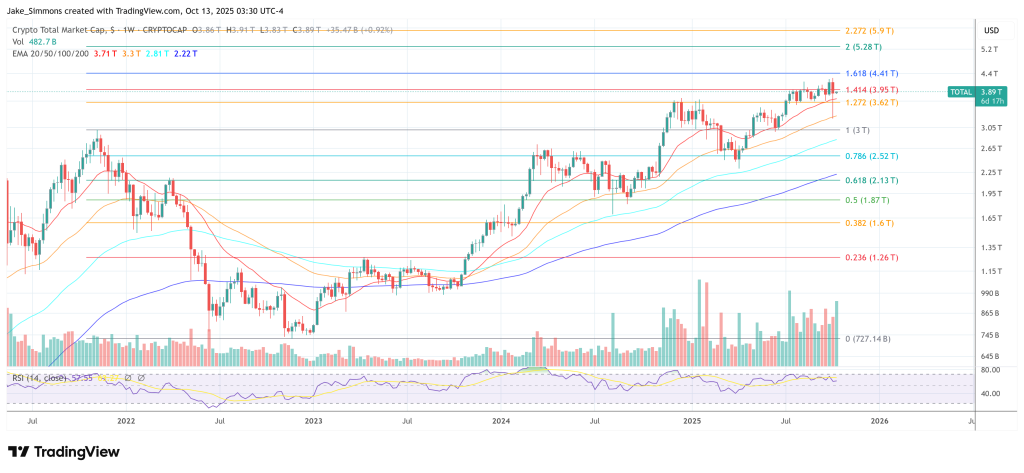
At press time, the total crypto market cap stood at $3.89 trillion.