

In a recent flurry of heated exchanges on social media platform X, Evgeny Gaevoy, the founder and CEO of crypto trading powerhouse Wintermute, has sparked a notable debate concerning the future of Ethereum and its leadership. Gaevoy, in a pointed critique, suggested that potential failures in Ethereum would not stem from technological competition like Solana, but rather from ideological contradictions within its own leadership.
Will Ethereum Fail Because Of Its Ideology?
Gaevoy’s remarks followed comments from Hayden Adams, known for his pioneering work on the Uniswap protocol, who had earlier expressed his tolerance and perceived value in meme-centric cryptocurrencies, emphasizing their role in promoting social causes. “I think there’s value to memetic attention and it’s cool to create markets for it. That said, the underlying purpose and value of the tech goes way beyond financial games,” he stated.
Contrasting with Adams, Gaevoy argued, “Blockchain tech is impressively super well conductive to create purely capitalist incentive-based systems. At the same time, Vitalik [Buterin], Hayden [Adams] and many others are trying to ‘solve capitalism’ […] You are either building capitalism or planned socialism. I’m sorry, you really can’t have both.”
He added that he’ll choose “capitalism in all its (often ugly!) glory. And if you are not here for glory, then one simple argument is – unlike socialism, capitalism actually works.”
This notion sparked a broader dialogue within the crypto community, attracting comments from other industry leaders. Ari Paul, CEO of BlockTower Capital, entered the debate suggesting Gaevoy’s view represented a “false dichotomy.” Paul analogized the situation to societal norms about propriety in shared spaces, such as elevators, arguing that just because one advocates for polite behavior does not mean they reject other priorities like safety or efficiency.
Gaevoy rebutted, emphasizing that the core functionality should trump less critical social preferences. He responded to Paul with a metaphor about optimizing elevators, “So the best elevators are the ones that don’t have farting people in them?” suggesting that focusing on minor issues like elevator etiquette over more significant technical characteristics could be misplaced.
Fiskantes, co-founder of Zee Prime Capital, elaborated on this metaphor, distinguishing between expressing a preference and redesigning systems around niche issues. He argued that stating a preference against sharing an elevator with a ‘farting person’ is vastly different from redesigning the elevator to specifically include anti-fart features, potentially at the expense of more critical functionalities like safety and speed.
Furthering the discourse, Mike van Rossum of Folkvant Trading defended the intentions of Ethereum’s leaders. He highlighted that Adams and Buterin’s critiques were not against capitalism per se but against trends within the crypto space that may not be sustainable or conducive to long-term progress. Van Rossum explained, “They both have a certain vision of crypto […] they just want to say ‘I don’t like this’, and that’s pretty much all they did,” suggesting a nuanced view that accommodates both capitalist frameworks and selective ideological stances.
Gaevoy concluded the debate by clarifying his stance on the foundational principles of crypto projects. He stressed the importance of adopting capitalism not merely as an afterthought but as a central guiding principle. He asserted, “If your key guiding principle is capitalism and then you make extra steps to make it less damaging – I’m all for it. If your guiding principle is, idk, ‘social justice’ or ‘only good things should be built’ and then you attach capitalism as an afterthought, that’s what I am against.”
The debate underscores a critical junction for the crypto community, reflecting a broader ideological struggle about the direction and use of blockchain technology. As these discussions continue to unfold, they not only influence public perception but also shape the strategic decisions that will determine the future of Ethereum and similar blockchains.
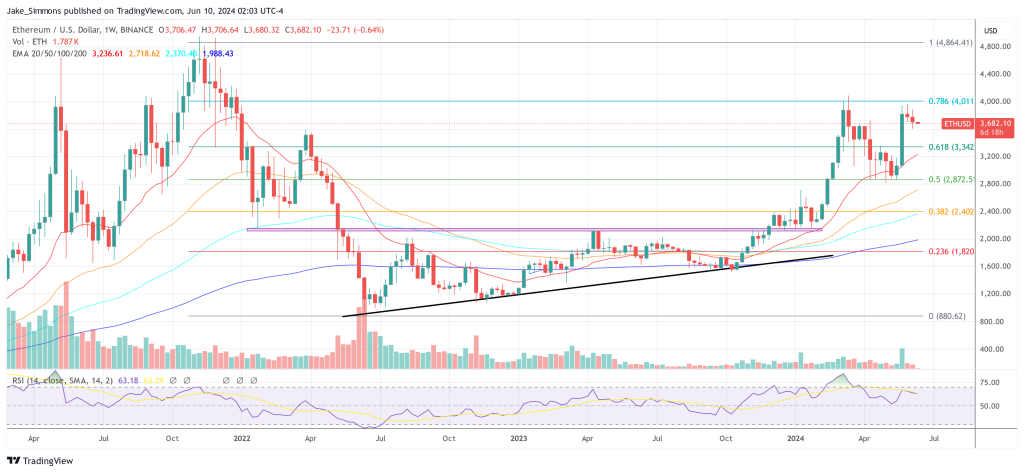
At press time, ETH traded at $3,682.