

Anza—the firm leading core software development for Solana—has begun detailing “Rotor,” a new block-propagation layer shipping with the Alpenglow consensus overhaul. In a thread on X, Brian (@0xbrw), Anza’s developer relations lead, claims Rotor will put Solana ahead of Ethereum on raw network responsiveness: “Rotor is Solana’s new block propagation method in the Alpenglow upgrade… [it] delivers data faster and more uniformly than Ethereum’s peer-to-peer gossip.”
Solana Vs. Ethereum
Brian describes Rotor as “a structured, single layer of relayers that replaces Turbine’s multi-layer tree,” with the slot leader sending erasure-coded “shreds” to those relayers, who then “complete block distribution in one hop to validators worldwide.” In his words, it “cuts hops and tightens the tail of arrival times,” so “more validators receive the block at nearly the same moment.” The promised effect is fewer late arrivals and fewer forks rooted in propagation skew.
The mechanics depart sharply from today’s Turbine retransmit tree. Under Rotor, “the leader pipelines a block into slices, erasure codes each slice into shreds, and sends each shred to a selected relayer. Relayers broadcast to all validators in one round, prioritizing the next leader to keep scheduling smooth.” Brian’s emphasis is on end-to-end timing predictability: “lower latency, tighter consistency, and headroom for larger blocks.”
Brian sets that against Ethereum’s networking path: “Ethereum relies on multi-hop gossip where blocks ripple outwards in steps, which can take multiple seconds to reach distant nodes.” On Ethereum, a proposer initially gossips to “~8” peers and a block typically travels “6–7 hops” before most nodes see it, with each hop adding transmission and verification overhead. Rotor, he argues, sidesteps that compounding delay by parallelizing distribution via one-hop relayers.
The practical pitch targets both builders and operators. For developers, Brian promises “lower end-to-end latency, steadier confirmation times, and fewer surprise stalls under load,” making “trading, payments, and games” smoother “as blocks circulate more predictably.” For validators, he points to “fewer missed slots from slow delivery, less bandwidth wasted on redundant resends, and more predictable network load.” In short, “Rotor replaces Turbine’s multi-hop with a one hop,” aiming to distribute “large blocks almost as fast as a direct, single-packet message.”
Anza is positioning Rotor as a core pillar of Alpenglow “alongside voting and finalization,” a reference to Votor—the consensus path that targets sub-second, deterministic finality. Anza’s May blog calls Alpenglow “the biggest change to Solana’s core protocol since, well, ever,” and outside explainers from ecosystem providers reach similar conclusions about the scope of the upgrade.
It is also material that the messenger speaks for the team building the reference client. Anza describes itself as “the leading Solana-focused software development firm”; its core engineering group maintains Agave, a production Solana validator client forked from the original Solana Labs codebase, and contributes to consensus, networking and validator performance. Those roles give the company unusual authority over how ideas like Rotor move from whitepaper to running code.
Solana’s Current State
Context from Anza’s public documentation helps frame the change. Turbine, Solana’s current propagation protocol, uses a layered tree where each node forwards shreds to a small downstream set; this structure limits per-node bandwidth but can amplify tail latency when any branch slows. Rotor collapses that tree into a single dissemination layer and explicitly sequences delivery to the next scheduled leader, a detail intended to smooth slot hand-offs and reduce stalls.
Brian’s claim that the upgrade will make Solana “superior” to Ethereum should be read precisely: it is an assertion about propagation speed, latency consistency, and the user-visible smoothness of confirmation under load, not about every dimension of network design. Ethereum’s research community continues to iterate on GossipSub parameters and overlay strategies, while Solana still has to prove Rotor’s one-hop relay layer under adversarial and high-churn conditions. But taken on its own terms, the argument is clear—and, from the team leading Solana’s core software, unambiguous. “Rotor… delivers data faster and more uniformly,” Brian wrote. “The result is lower latency, tighter consistency, and headroom for larger blocks.”
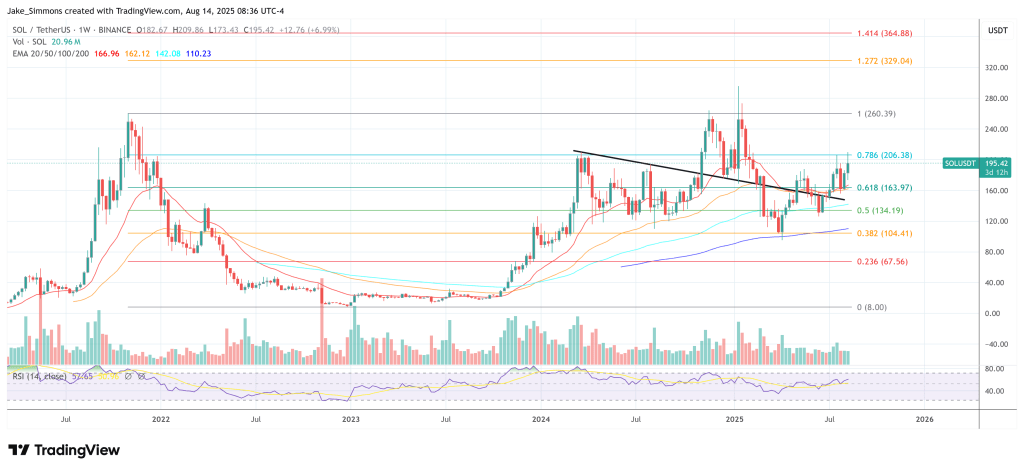
At press time, SOL traded at $195.