

A House of Representatives lawmaker has introduced a bill that could codify President Trump’s executive order and allow crypto and other “alternative assets” to be included in 401(k) retirement plans.
House Lawmaker Moves To Codify Trump’s EO
On Tuesday, House of Representatives member Troy Downing proposed a bill to codify President Donald Trump’s Executive Order (EO), which aimed to democratize access to alternative investments for 401(k) investors.
Representative Downing introduced the Retirement Investment Choice Act in the House Financial Services Committee, supported by Republican Representatives Byron Donalds, Warren Davidson, Marlin Stutzman, Buddy Carter, and Barry Moore.
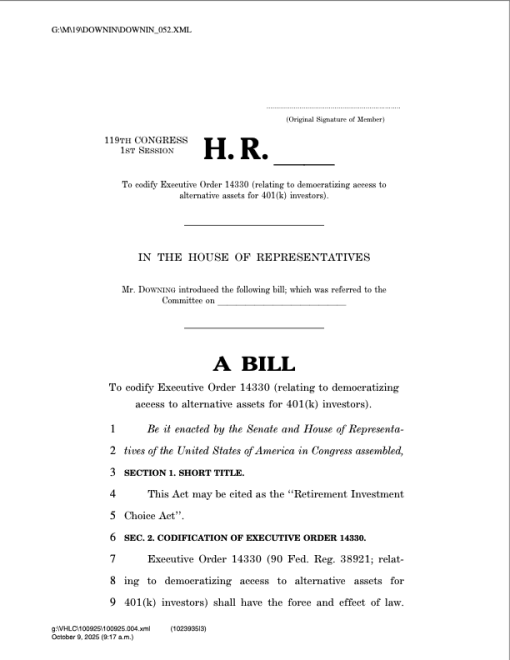
If approved, the proposed bill will give President Trump’s EO “the force and effect of law,” making it easier for investors to access cryptocurrencies and other alternative assets in their 401(k) retirement plans.
In August, President Trump signed Executive Order 14330 that aimed to allow more private equity, real estate, cryptocurrency, and other alternative assets in 401(k) retirement accounts.
The EO directed the Department of Labor (DOL) and the Securities and Exchange Commission (SEC) to reduce regulatory barriers that prohibit investments in alternative assets in their defined contribution retirement plans, and to clarify or revise rules that could help shield the industry from litigation risk.
Representative Downing affirmed that “alternative investments hold the transformative potential to supercharge the financial security of countless Americans saving for retirement.” “I applaud President Trump for his leadership to democratize finance and am proud to be leading the effort in Congress to codify his EO and enshrine this move for generations to come.”
Crypto Push For 401(k) Retirement Plans
The push to add cryptocurrencies to retirement plans has gained momentum over the past few months. In May, the US Department of Labor (DOL) rescinded its 2022 guidance, which discouraged fiduciaries from including crypto asset investments in 401(k) retirement plans.
The direction, issued in March 2022, followed Former President Joe Biden’s executive order, which required the government to assess the risks and benefits of digital assets.
The EO instructed plan fiduciaries under the Employee Retirement Income Security Act (ERISA) to exercise “extreme care” before adding crypto assets to their investment menus, asserting that the digital asset industry’s early stage could pose significant risks.
US Secretary of Labor Lori Chavez-DeRemer explained the agency was “rolling back this overreach and making it clear that investment decisions should be made by fiduciaries, not DC bureaucrats.”
In September, Representative Downing joined Financial Services Committee Chairman French Hill and seven other Committee members on a letter supporting the executive order. As reported by Bitcoinist, a group of US lawmakers sent a letter to SEC’s Chairman Paul Atkins highlighting the EO’s potential to enhance retirement savings for millions of Americans.
Notably, the lawmakers emphasized the importance of allowing access to cryptocurrencies and other alternative investments in 401(k) plans, arguing that they could improve net risk-adjusted returns for retirement accounts.
The letter urged the SEC to collaborate with the DOL to revise existing regulations and ensure that these alternative investment opportunities become accessible to a broader range of investors.
Nonetheless, the efforts to develop legislation that opens access to these alternative assets have received backlash, which might suggest that the recently introduced bill could also face opposition.
Last week, the largest US federation of trade unions urged US lawmakers to reject the Senate’s version of the crypto market structure bill, citing serious concerns and a lack of adequate safeguards for workers and their retirement plans.
Jody Calemine, Director of Government Affairs at The American Federation of Labor and Congress of Industrial Organizations (AFL-CIO), sent a letter to the US Senate Banking Committee, arguing that the bill’s treatment of crypto assets posed a risk to both retirement funds and the overall financial stability of the US economy.