

The latest What Bitcoin Did episode, hosted by Danny Knowles, turns squarely to the question stalking one of the market’s hottest trades: can the boom in “Bitcoin treasury” companies withstand the next prolonged drawdown? Dylan LeClair, who helps lead the Bitcoin strategy at Tokyo-listed MetaPlanet, argues the answer rests less on ideology than on balance-sheet engineering, scale, and the willingness to endure volatility without blinking. “There’s sort of a ‘gradually then suddenly’ inflection point,” he said, describing how corporate exposure to Bitcoin has migrated from gimmick to boardroom agenda. The shift, in his view, is irreversible, but survival “is a constant fight with gravity” for firms that trade at premiums to their net asset value (NAV).
Why Some Bitcoin Treasury Companies Won’t Survive The Bear Market
LeClair’s thesis starts with market structure. Bitcoin is homogeneous collateral, but public equities are not. Liquidity, index inclusion, and the absolute size of a balance sheet produce a “winner-take-most dynamic,” he said. Even where two issuers have the same headline premium, the gravity of size changes the calculus: “Strategy is at a measly 1.8x premium, but the premium is like $50 billion of value,” he noted, contrasting that with the far smaller absolute premia attached to emerging players. Premiums compress mechanically as companies buy more Bitcoin or as the price rises, he added, which means maintaining a rich multiple demands ever-larger inflows of capital.
Pressed on what a bear market would do to those premia, LeClair separated cycle folklore from funding reality. He does not buy the inevitability of a 70% “pack it up for three years” drawdown as a base case, arguing the market now tends to reprice and then chop for extended periods. But he is unequivocal that a risk-off phase would punish sloppy balance sheets. “There will be pressure on MNAVs… Are you levered? With what sort of debt? Do you have secured debt where your Bitcoin’s encumbered? Do you have debt due in one year?” By contrast, he pointed to perpetual preferred equity—dividends but “no debt maturity ever”—as a structure that removes the most dangerous cliff: “With the prefs it’s like, no, we’re not selling actually ever.”
For MetaPlanet, he framed risk management in deliberately dull terms: “We’re focused on staying… pristine, maintaining maximal flexibility.” He cited a “BTC rating” of roughly 16.5x—“we have 16 bucks of Bitcoin for every dollar of debt”—as intentional dry powder rather than under-optimization. The stress test, to him, is behavioral as much as financial: can management “eat the 70% bear market” if it comes? He expects casualties. “It’s naive to say that every company that adopts Bitcoin will be a success… there will be failures. There will be a bankruptcy… it’s a brutal, competitive world.”
Where, then, is the moat? Not merely in being public, he argued, but in graduating from equity capital to the far deeper fixed-income markets. Convertibles provided early leverage—but at a cost he described with traderly bluntness. Convertible desks “woo you,” then short aggressively to hedge, “dampening the volatility” that many treasury companies actually want in their common stock. The more durable solution, he said, is permanent capital in the form of preferred equity. Here he credits Michael Saylor’s Strategy (formerly MicroStrategy) with reaching “escape velocity,” pioneering a layered capital stack that now includes a new variable-rate preferred dubbed “Stretch” (ticker: STRC).
Stretch is engineered to keep trading near $100 by adjusting its dividend and, if necessary, issuing new shares or calling them at $101—“a pretty genius feat of financial engineering,” in LeClair’s words, because it behaves like a cash-equivalent for investors without imposing maturity cliffs on the issuer. Strategy priced STRC in late July with an initial dividend framework and then closed a multi-billion-dollar offering, with the company describing the instrument as variable-rate, perpetual preferred stock designed to pay monthly and target trading near par.
LeClair sees this as the practical realization of a long-standing ambition in crypto finance: a dollar-like instrument tied to Bitcoin collateral, without forcing asset sales in stress. Unlike algorithmic stablecoins that were vulnerable to redemptions spirals, Strategy’s preferreds are senior to common equity and massively over-collateralized by transparent Bitcoin holdings, he argued. External observers have reached similar high-level descriptions: Strategy’s own materials emphasize STRC’s variable dividend on a stated $100 amount, while coverage in financial media notes the offering’s explicit aim to hew to par and its place alongside earlier preferreds (Stride, Strike, Strife) in a capital stack backed by tens of billions in unencumbered Bitcoin.
All of this feeds the consolidation logic LeClair expects in a downturn. Preferreds, he said, are both offensive and defensive. Offensively, they add dry powder to buy more BTC or even buy back common if MNAV compresses, reversing flow against short sellers “playing this spread game.” Defensively, they function as an “MNAV defense mechanism,” easing reliance on converts and the gamma-trading that “neuters volatility” in the common. If markets turn, he anticipates classic Wall Street behavior: opportunists will “clear off some debt, buy the Bitcoin at a discount.” MetaPlanet, he added, is not seeking to be a roll-up; the focus is “laser” on BTC itself.
Could Anyone Catch Strategy?
LeClair is diplomatic on peers bringing large private Bitcoin pools public, calling it “overwhelmingly positive” for the asset. But his competitive assessment is stark: “I think Saylor’s reached escape velocity… a 600,000 Bitcoin lead is pretty insurmountable.” To contextualize that claim with public data, Strategy now reports roughly 629,000 BTC, giving it a commanding lead over other corporate holders.
He adds that only a mega-cap with a decisive pivot—“if Mark Zuckerberg took the orange pill tomorrow”—could realistically challenge, which he deems unlikely given competing priorities like AI.
LeClair is no maximalist about smooth sailing. Premiums will ebb. Funding windows will open and slam shut. Some firms, he warned, are “cosplaying as Bitcoiners” and may abandon discipline at the first whiff of pain. He was also frank about the sector’s self-selection bias: during the good times, new “treasury companies” appear by the week; the real filter arrives when prices fall and maturities near. “The times are good now… there will be a cycle. That’s what will separate the men from the boys,” he said. Survival, in his telling, comes down to a few non-negotiables: unencumbered collateral, long-dated or perpetual liabilities, and management that will not sell into downdrafts.
Yet his broader message is that the game board has changed. Corporate adoption remains “early innings,” he said, because “the rest of the world actually simply doesn’t care” yet. The depth of the credit markets—and the emergence of Bitcoin-backed instruments palatable to those markets—may be what finally does the persuading. “If Bitcoin is going to eat the world… it has to get to all these different pools of capital.” Treasury companies that make that leap, he believes, can not only endure a bear market—they can use it to widen the gap.
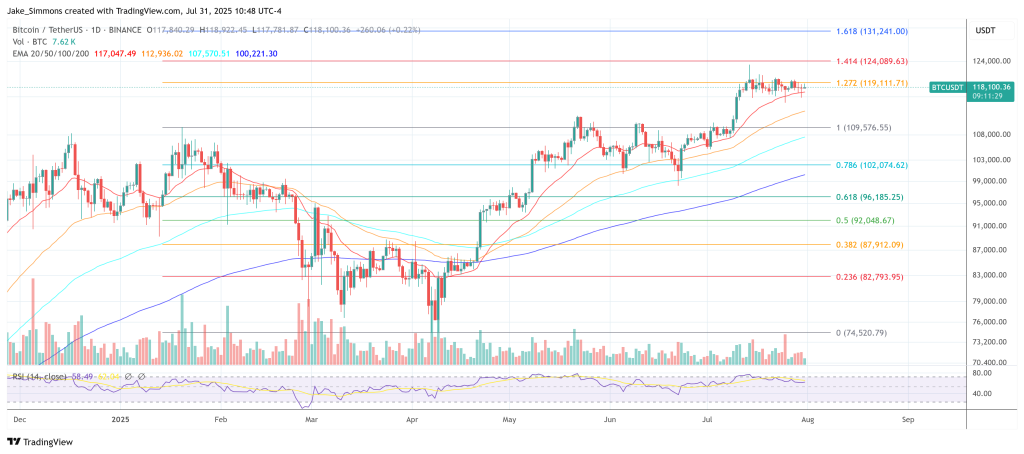
At press time, BTC traded at $118,100.