

In a new report, Christine Kim of the Galaxy Research team delves into the intricate governance of Ethereum, revealing how this blockchain, which underpins over 4,000 decentralized applications (dapps) and houses the largest developer community among blockchain platforms, is governed through a complex yet unofficial series of off-chain processes that involve multiple stakeholders. Ethereum, as a trailblazer in blockchain technology, follows a unique governance path distinct from Bitcoin, leaning on community-driven, decentralized processes rather than on-chain governance mechanisms.
Here’s Who Controls Ethereum
Ethereum operates a decentralized and off-chain governance system, a deliberate design to prevent undue influence by large ETH holders or potential attackers. “Ethereum’s governance is off-chain and coordinated through various community forums rather than through direct voting mechanisms embedded within the blockchain itself,” Kim notes, emphasizing the system’s resistance to manipulation. Discussions and decisions occur across various digital forums including GitHub, Ethereum Magicians, and developer calls, without direct community voting on the changes themselves.
At the core of ETH’s governance lies the Ethereum Improvement Proposal (EIP) system, which facilitates the formal proposal, discussion, and implementation of changes to the protocol. EIPs are divided into three categories: Standards Track EIPs that suggest crucial protocol changes; Meta EIPs aimed at governance alterations; and Informational EIPs that provide guidelines to enhance community practices.
“EIPs are the primary mechanism through which new features and functionalities are proposed, discussed, and implemented into the protocol,” Kim asserts, underscoring the process that ensures only well-vetted proposals influence the blockchain’s evolution.
The governance landscape of ETH is populated by a diverse array of contributors, each playing distinct yet overlapping roles. The Ethereum Foundation, although influential in the early days, now shares its significant but not unilateral influence with developers, client teams, node operators, and dapp developers. Kim points out, “No single party controls the development of the Ethereum protocol, which is a collective effort by various stakeholders in the Ethereum ecosystem.”
Core developers and client teams like Geth or Prysm hold the technical reins, integrating EIPs into the protocol and maintaining the client software. Node operators have the practical authority over changes, as they choose whether or not to adopt new software releases, essentially deciding on the activation of upgrades. Meanwhile, dapp developers provide crucial feedback and push for changes that affect their applications directly, representing the front line of users interacting with ETH’s codebase.
The report highlights the consensus-building process using the example of Ethereum’s transition to Proof-of-Stake (PoS) with The Merge. This major upgrade was not just a technical overhaul but a test of ETH’s governance model, demanding broad agreement across various stakeholders. “The transition to PoS, known as the Merge, required significant technical coordination and broad consensus across multiple stakeholder groups, demonstrating Ethereum’s capability to manage large-scale, complex changes,” Kim explains.
Looking forward, the governance is expected to face growing complexities as the platform scales and integrates new technologies. Kim suggests that the governance processes will need to adapt to maintain their effectiveness and inclusiveness. She forecasts, “Maintaining a decentralized governance model is crucial as ETH continues to scale and incorporate more complex features and upgrades.”
Kim’s comprehensive analysis concludes that Ethereum’s governance is characterized by its decentralized, community-driven approach where no single entity has control. Instead, a dynamic interaction among various stakeholders shapes the protocol’s evolution. This model not only protects the network from centralization but also encourages an environment ripe for continuous development and innovation.
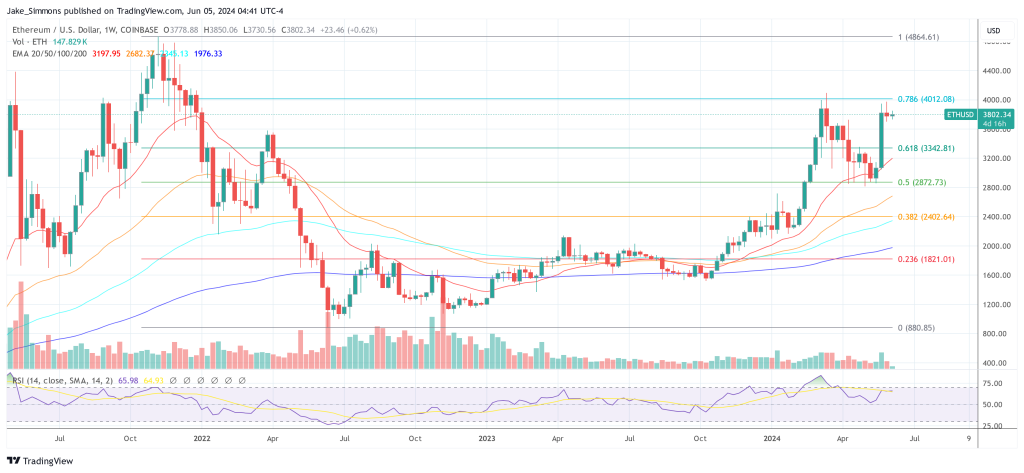
At press time, ETH traded at $3,802.