

The XLS-40 amendment on the XRP Ledger, which introduces a new standard for Decentralized Identifiers (DIDs), was activated on October 30. Approved by 28 out of 35 validators (85.71%), the amendment went live yesterday.
Mayukha Vadari, a Senior Software Engineer at RippleX, announced the activation via X (formerly Twitter), stating: “The XRPL DID amendment goes live today! DIDs (Decentralized Identifiers) in web3 can be pretty confusing, when looking into how they work. Here’s an explainer for XLS-40 and DID on the XRPL!”
XRP Ledger Gets Decentralized Identifiers
DIDs are unique, user-owned identifiers that are not controlled by any central authority. Vadari explained, “A DID is roughly equivalent to a fingerprint in the real world. Everybody has one, and though it doesn’t really do anything on its own, it’s useful in other contexts. For example, it can connect to Verifiable Credentials (VCs) or other data that prove who you are without relying on a centralized authority.
These identifiers are designed to be “persistent, globally resolvable, cryptographically verifiable,” and compatible with any distributed ledger or network, adhering to the World Wide Web Consortium (W3C) specifications.
The XLS-40 DID specification was developed by Aanchal Malhotra and Vadari. She elaborated on the implementation: “A DID is represented on-chain via a series of two-way links (bidirectional pointers). The user creates a DID document and links to it in their on-chain DID object on the XRPL. The DID document also refers to the on-chain DID object, so there’s no way for someone else to forge your identity. In other words, the document says your account is part of its identity, and the account says that the document is its identity.”
When users sought clarification on the mechanics, one asked, “Creates when and how?” Vadari responded, “There’s a new transaction called DIDSet.” This new transaction type enables users to establish their DIDs on the XRP Ledger, facilitating the creation and association of a DID with an XRPL account.
Addressing concerns about potential identity forgery, a user inquired, “Ok, so what is preventing me from copying someone else’s document and assigning that to my new DID identity?” Vadari clarified, “Their document won’t point back to your identity, so it won’t be valid.” The bidirectional linking between the DID document and the on-chain DID object ensures the authenticity and integrity of the identity, preventing unauthorized duplication.
Another user, BitCrypto, posed a question about managing multiple identities: “What prevents a person who has multiple accounts from creating a DID for each of them, making that person a different person each time they use one of those accounts?” Vadari acknowledged the possibility: “If you want to do that, that’s totally fine. Just like how you probably have some social media accounts that aren’t connected to your real-world identity.”
According to information from xrpl.org, a Decentralized Identifier (DID) is a new type of identifier defined by the W3C that enables verifiable, digital identities. DIDs are fully under the control of the DID owner, independent from any centralized registry, identity provider, or certificate authority.
The key principles of a DID include decentralization, verifiable credentials, and interoperability. Decentralization ensures that no central issuing agency controls the DID, allowing the owner to update, resolve, or deactivate it independently. This also enhances availability, as DIDs are usually stored on a blockchain and always available for verification.
Verifiable Credentials (VCs) are crucial because, while anyone can create a DID and potentially falsify information, the authenticity is established through a VC that is cryptographically secure and tamper-evident. In the DID ecosystem, there are three parties involved: the user (who controls the DID), the issuer (a trusted entity that verifies the information offline and provides the VC), and the verifier (who needs to confirm the user’s identity).
Interoperability means that DIDs are open to any solution that recognizes the W3C DID standard, enabling them to be used to authenticate and establish trust in various digital transactions and interactions.
On the XRP Ledger, the implementation of DIDs conforms to the requirements in the DID v1.0 specification. The process involves an XRPL account holder generating a DID that is controlled by their account. The DID is associated with a DID document as defined by W3C specifications. When a user provides their DID and VC to a verifier for a digital task, the verifier resolves the DID to its document and uses the VC to verify its authenticity.
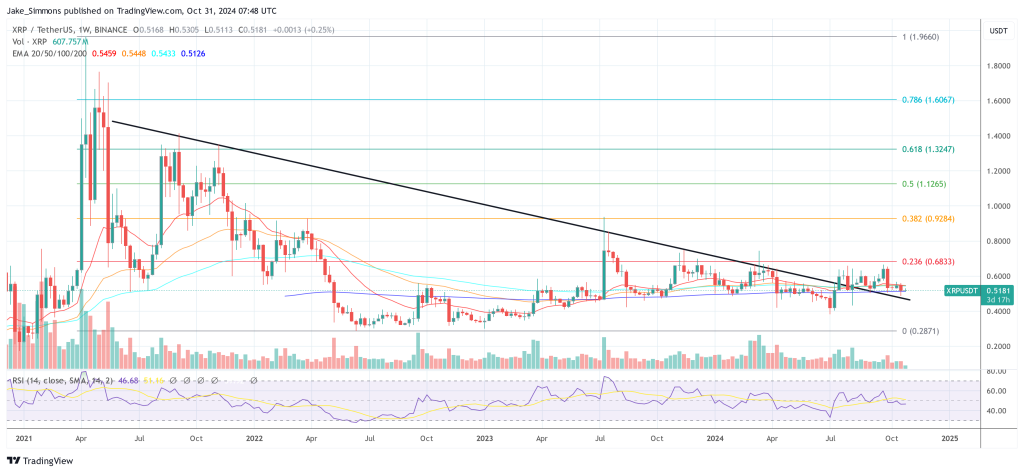
At press time, XRP traded at $0.5181.