

The XRP Ledger activated its Multi-Purpose Token (MPT) standard on October 1, turning on a native, protocol-level framework for issuing and governing fungible tokens that aims squarely at institutional tokenization—without relying on bespoke smart contracts. “The Multi-Purpose Token (MPT) standard is now live on the XRP Ledger mainnet,” wrote Ripple engineer Kenny Lei on X.
“It’s a new native token standard designed to make issuing real-world assets onchain far simpler, safer, and more aligned with how financial institutions operate.” Lei underscored the architectural departure from prevailing models: “Unlike most token standards, MPT isn’t built with custom smart contracts. It’s embedded directly into the protocol.”
XRP Ledger’s MPT Targets Ethereum’s Institutional Gap
That design choice is the point. On Ethereum, fungible assets such as ERC-20, or security-oriented frameworks like ERC-1400 and ERC-3643, are implemented as smart contracts at the application layer. By definition they must encode and enforce rules in contract code and coordinate with auxiliary registries, identity modules, or compliance oracles.
In Ethereum’s own documentation, an ERC-20 token is “a Smart Contract…responsible to keep track of the created tokens,” and security-token standards add optional modules for transfer controls, allowlists, document references, and operator roles—all still delivered as contract logic. MPT inverts that stack order by putting core controls in XRPL’s base protocol rather than in per-issuer contracts.
Lei’s thread framed the business problem: institutional pilots routinely stall over audit scope, bespoke logic, and regulatory uncertainty. MPT’s claim is to standardize those frictions away. As shipped, issuers can attach compliance and lifecycle semantics to a token “out of the box,” including KYC/AML authorization and allowlists, issuer-defined transfer rules, freeze and clawback rights, on-chain metadata for reporting and disclosure, and multi-signature or delegated key management.
Ripple’s institutional roadmap, updated in late September, positioned MPT as the “language of real assets”—able to carry maturity schedules, tranche identifiers, eligibility constraints, and recovery mechanisms natively, with confidential variants slated to enable privacy-preserving transfers. “MPT offers a protocol-level upgrade that makes XRPL more useful for regulated finance, while still staying true to its principles: simple, efficient, and built for utility,” Lei wrote.
The standard’s immediate scope targets the bread-and-butter of institutional tokenization. Lei listed use cases that match regulator expectations: bonds with coupon schedules, share classes with investor eligibility rules, stablecoins with recovery processes, fractionalized real-world assets, tokenized money market funds, closed-loop loyalty instruments, and collateral that can plug into what Ripple calls “Institutional DeFi.”
The company’s September brief mapped those MPT assets to a forthcoming native lending protocol in XRPL v3.0, an “MPT DEX” path for secondary trading, and a roadmap to “Confidential MPTs” integrated with zero-knowledge tooling. In Lei’s words: “MPTs are core building blocks for institutional DeFi: they’ll underpin vault share issuance in the Lending Protocol, unlock seamless secondary market activity with MPT DEX, and support future Confidential MPTs.”
For critics, the timing and approach will invite comparison to Ethereum’s decade of ERC standards. One community member cautioned that established ERC security-token frameworks have been “tried and true,” and suggested that extending XRPL’s earlier trust-line model might have been less disruptive.
Lei responded that XRPL’s AMM/DEX support for MPTs is shipping incrementally rather than in one sweep, with the current feature set intended to lay down durable primitives as the rest of the stack catches up. “AMM/DEX support for MPTs is coming soon! We are looking to build incrementally instead of introducing one big change. The current MPT feature sets a strong foundation to build upon,” Lei concluded.
The contrast to Ethereum is stark precisely where regulators focus: who can hold what, when can transfers be paused or reversed, how are issuer rights constrained, and where do disclosures live. In Ethereum’s universe, ERC-1400-style capabilities—whitelists, transfer restrictions, document links, and operator roles—are durable but optional and variably implemented across contract libraries.
MPT’s bet is that moving those controls into the ledger itself will lower integration cost and compliance ambiguity for conservative issuers. That is what the headline’s provocation—“promises what Ethereum can’t deliver”—is pointing at: not functional impossibility, but a different trust and assurance model rooted in protocol guarantees rather than contract conventions.
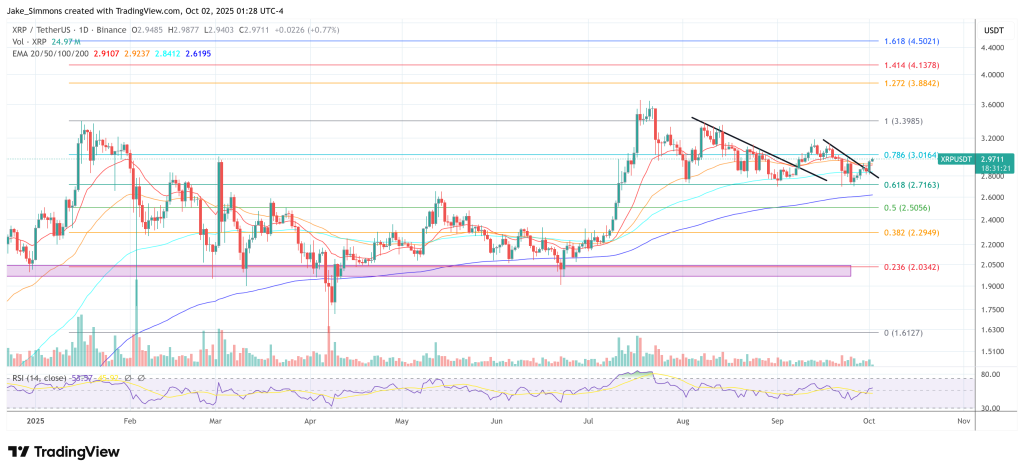
At press time, XRP traded at $2.97.